On the Pennsylvania Turnpike from Harrisburg to
Philadelphia, I passed a billboard with lettering in fluorescent green that
seemed to ooze and drip down the sign:
nogreenslime.com.
I knew instantly they were talking about me and the thousands
of committed citizens working to tell the truth about the “black slime” of the
oil and gas industry and move our economy to a sustainable, greener
future. According to the website, we are
green “slime” because of the “propaganda, deliberate misinformation,
distortion, and junk science” that is thrown out there to try to stop the
growth of the oil and gas industry. The
myths of energy independence, employment, tax windfalls, and the inadequacy of
non-fossil-fuel energy sources are touted by the site.
According to the site, we are “community activists, national
environmental groups, academics and biased public-interest organizations.” We are “advancing an agenda that will prevent
your energy costs from going through the roof with the ridiculous idea that
renewable sources can provide enough energy to meet your needs.” We have “deliberately implemented a deceiving
and negative campaign about oil and natural gas development to paint a more
favorable picture of expensive, inefficient renewable energy.”
Considering the billions of dollars raked in by the oil and
gas industry, and the utter selflessness with which environmental activists
give of their time, energy and personal finances, one wonders what the industry
thinks is our primary motivation. The
industry is obviously in it for the money.
What are we in this fight for? If
it was for money or fame, most of us would have gotten out long ago. The defamation and despair that comes with
this battle is enough to make even the hardiest activist burn out. I can only speak for myself, but I do this
work because it is a calling from God to do all that I can to protect my
children’s - and all children’s - future from the ravages of fossil fuels on
our economy, our most vulnerable citizens, and God’s Creation. When my future grandchildren look at the
devastation of climate change and dispersed industrialization of fossil fuels
and ask me, “What did you do?” I have to be able to look them in the eye and
say, “Beloved, I did everything thing I could.”
And if things turn around and we avoid the worst-case-scenario of global
climate disaster and, by God’s grace, enter a truly Ecozoic Age that honors Earth
and Earth’s children, I will be able to say to them, “Beloved, I did everything
I could.”
And for this I am called “green slime.”
The choice of words is interesting. Slime feels icky and sticky. Green slime is used in kids’ t.v. game shows
when the loser gets “slimed.” We are
described as “slime peddlers” who “have tried to pitch new and easily refuted
boogey-monster-style stories.” Boogies,
snot, slime. The lowest of the low. The ickiest of the ick. It seems an ingenious way to sneeringly
dismiss the environmental movement. The
tactics are familiar – the group in power uses dehumanizing language to discredit
and delegitimize the marginalized minority.
It is also an indication that the movement has grown strong enough that
a paid billboard on a PA highway is actually necessary to “debunk” the green slimers. Never mind that the fact that the real slime is
leaking out of pipelines in Arkansas,
gushing out of fracked well sites,
and
contaminating the waterways of our Earth.
But what the oil and gas industry is forgetting is the other
kind of green slime that comes in the form of algae, kelp, seaweed and
countless other forms of watery plant life.
The vast variety of algae found the world over is capable to deriving
energy from the sun and predates any form of plant or animal life found on
land. It is from this primordial green
ooze that all life arose and upon which all life still depends at one level or
another. Though lowly and easily
dismissed, green slime in the form of algae is a powerhouse that may yet become
the primary source of fuel for our world http://en.wikipedia.org/wiki/Algae_fuel.
So to my friends in Shale Justice, Protecting Our Waters, Responsible Drilling Alliance,
PennEnvironment, and the many other organizations vilified by
the oil and gas industry on this and many more websites like it, I say: embrace your inner green slime! Continue to speak truth to power. Do not let them poison your spirit like so
much biocide poured down the fracking drill hole meant to kill all microscopic
life-forms that may gum up their works.
Continue to grow and wrap yourselves around their machines like seaweed in
their gasoline engine. Green slime? You betcha!
Available on Amazon for Kindle download, $.99. http://www.amazon.com/Downriver-ebook/dp/B00BL7VFE6 Waite’s e-book is a series of six vignettes that give us
brief yet compelling glimpses of life in America moving between rural and
suburban landscapes and communities. I
have lived in both places and found myself nodding in recognition of the details
in these tiny portraits. Waite
beautifully captures a child’s perspective on a farmer-neighbor’s death, the
twang of conversation between two old friends reminiscing, and the humorous family
drama of a canoeing trip.
The opening piece “Fractured” is a taut short
story about friendships, farms, communities and cows negatively affected by the
shale gas industry. While the story is
realistic fiction not based on actual events, the circumstances of a farmer
faced with the decision to lease his land to drilling or face the demise of his
farm is all too common in Pennsylvania and Ohio. The tragic irony is that his decision results
in more loss than he, his wife, or his friends could have ever anticipated . . . Read the rest of the review here: http://ecowatch.com/2013/downriver-fracking-and-consumerism-eroding-rural-communities/
“Never doubt that a small group of thoughtful, committed citizens can change the world. Indeed, it is the only thing that ever has.”That quote, one of my favorites, is attributed to the anthropologist Margaret Meade. And our passage from Acts about Pentecost is a great example of this quote.
They were just a handful of bedraggled disciples of a rabbi who had been crucified as an enemy of the state. But after encountering the risen Christ, that “trickster” we talked about on Holy Humor Sunday, and seeing him ascended into heaven, the disciples were told to wait in Jerusalem for the gift of the Holy Spirit. As they waited in that upper room, the Trickster Christ had yet another surprise for them. The wind from God swept across them, dropping little flames of fire over each of them. They were whipped into such a frenzy of laughter and joy, people thought they were either drunk or crazy. That’s what the Holy Spirit does – lights a fire in people’s souls.
And when those little sparks get out into the world, watch out! The fire of justice and God’s love through Jesus Christ swept across the land and burned in the hearts of hundreds, thousands who longed for God’s power to do something in their lives, in their world, to make a difference, and start a world-changing revolution.
So what surprises is God doing among us today? And what does it look like when the Holy Spirit shows up and creates new hope, new community, and new joy with a small group of citizens? Let me tell you a story about where I saw the Trickster Jesus surprise me and a whole community of people with Pentecost joy.
Once upon a time in the not-too-distant past there was a little village nestled snug along a wide and winding river.
The villagers shared their land with deer and foxes, bear and geese, and, of course, the creatures that dwelled in the waters of the river. Children rode their bikes down the lanes that ran between the grassy lots of the houses.
Neighbors visited each other in the evenings and had barbeques and picnics in the warm summer evenings. The villagers were humble, hard-working people, but they did not have much money. Their houses were not-so-very-big and made of metal. But many of them decorated their porches with flowers and flags, and everyone trimmed their small, rectangular houses with colorful lights every Christmas. The neighbors felt safe in their little village. Everyone looked after each other’s children. And there was always someone looking in on the elderly neighbors, who always knew there would be a family to welcome them to their Thanksgiving table.
The villagers were not perfect people. But for thirty years, the families lived in the village in peace, grateful for the beauty of God’s creation around them and good friends and neighbors they could count on if there was ever a need. No matter how hard life would be at their jobs or at school, they always knew they could look forward to coming home to their little village nestled snug along the wide and winding river.
Until one day they came home to find letters posted on all their doors. The letters told them that the land underneath their homes had been sold, and they had to move away. A large company was going to tear down their houses and put in big buildings with big pipes going down to the river. The pipes would suck out the water, take it up to the mountains, and shoot it down into the ground to break the rocks deep below.
The villagers were very upset. They could not understand why their village was the place where the big buildings and pipes had to go. “It’s not fair,” they said. “What will happen to the deer and foxes, the bears and geese? What will happen to the river? What will happen to us?”
Some of the villagers moved out right away, stripping the metal from their houses to sell for a little bit of money.
In just a few weeks, the village was like a ghost town.
The families scattered to the surrounding countryside, leaving the village scattered with broken furniture, broken toys, and broken houses.
Some of the families took their homes with them, leaving behind porch steps leading to nowhere.
The old men no longer walked the lanes waving to their neighbors. The few children still left were too sad to ride their bikes any longer.
But some of the villagers remained. They did not want to move. They wanted to stay and protect their homes and the river. They sent word far and wide asking for help, for people to stand with them as they stood up to the company. On the day before the bulldozers were to come, people arrived from all over the land, answering the call of the villagers.
I was with them. You should have seen their faces when we arrived. They were so happy that we had come to be with them. We set a little table with thirty-two candles – one for each of the families who had lived in the village.
We read words from the Bible and other holy books about God’s love for the people and the land and water.
We prayed for justice and hope.
We cried with the villagers.
We filled bowls with water from the river and blessed them.
And then we held hands and promised to help the villagers.
As the sun set and the summer air cooled with the mist from the river, I said good-night to the villagers.
But the next day when I came back I got a big surprise! The helpers had taken all the broken pieces left in the village and made big walls across the road to block the bulldozers from coming in.
They created huge signs from old boards and bed sheets that said: “This is our community!” and “We are Americans!” and “This is a beautiful place! People live here!”
The porch steps had been moved to the center of the wall and the villagers stood on top, holding signs for all the cars and trucks passing by on the highway to see.
“Save our homes,” the signs read.
People driving by waved and beeped their horns. Even truck drivers who fractured the rocks honked their horns and waved.
For twelve days the villagers and their helpers kept the bulldozers away. They pitched tents and ate meals around campfires.
When it rained, they huddled in the abandoned homes to stay dry. They held circle meetings on the grass by the river to decide how to share chores and help the villagers.
They played with the children, brought instruments and sang songs, and created a whole new village out of the old one.
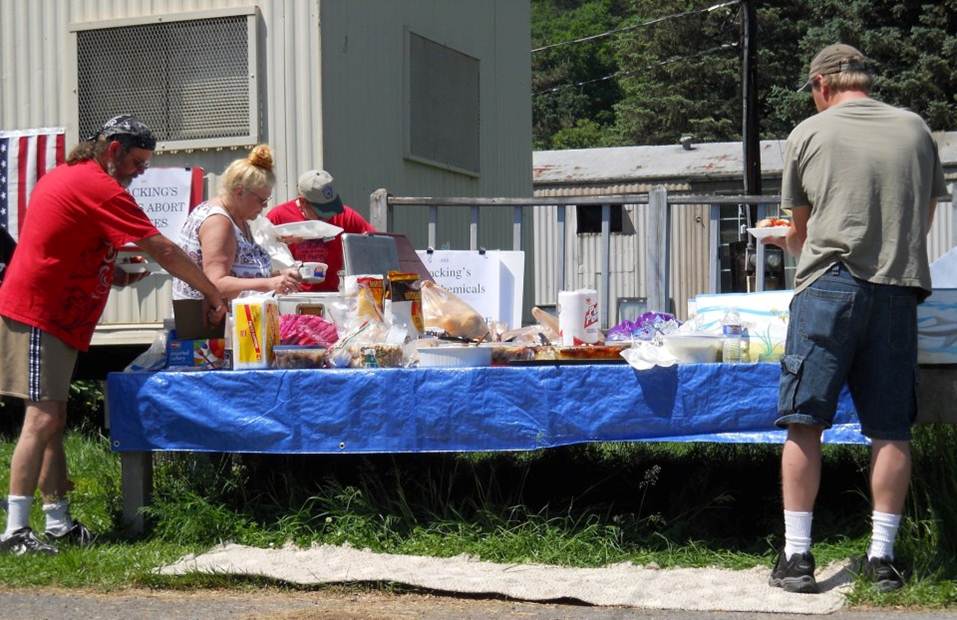
People from across the land sent food to the helpers. Even our church sent supplies – paper towels and cleaning supplies, food and drinks.
The villagers were so happy and grateful that we were helping them.
They were filled with joy, even though they were surrounded by so many broken things.
One of the villagers who had moved away even came back and took the roof off of his old home to make a big, colorful mural.
They got some paint, dipped their hands into the cans to make handprints across the mural and wrote words to describe who the villagers were: mother, truck driver, school bus driver, veteran, all painted in colors of the sky, purple and yellow flowers and green grass.
The village was called Riverdale. And it was exactly one year ago in that little mobile home park, surrounded by the remnants of a crucified community, that I began to see what resurrection looks like, and what happens when the Holy Spirit fills people with new hope. I saw a gathering of people around the foot of the cross, with nothing but death and destruction around them, proclaiming that hope is not dead. They were not all Christians. Most of them did not go to church. Most of the activists had no religious affiliation at all. But what I saw at Riverdale was a resurrection community, a Pentecost community, filled with the Holy Spirit. I saw the risen Christ, like the trickster he is, jumping out of the tomb yelling: Surprise! You can’t keep hope down. You can’t kill the love of God.
When I stood with those villagers in that decimated mobile home park, I knew what most people saw was just a bunch of low-class “trailer trash,” as they were called on the blog sites in Williamsport. I knew many people either pitied the residents for being caught in circumstances they couldn’t control, or thought of them as rabble-rousers, troublemakers, and trespassers. Some thought the villagers should just get out of the way and stop making such a scene.
Funny, that’s the kinds of things they used to say about Jesus and his disciples. That low-class carpenter’s son and his low-life fishermen rabble rousers, troublemakers and trespassers. The religious authorities and the military police just wanted them out of the way. Stop making such a scene! So they crucified Jesus and figured the disciples would just scatter and fade away.
That’s what eventually happened at Riverdale. On the twelfth day, men in uniforms came and put up plastic orange fences.
Police came and told the helpers that if they did not leave, they would be arrested.
The villagers told the helpers they did not want them to go to jail. So the helpers, with tears in their eyes and lots of hugs for the villagers, packed up their tents.
Today, the water withdrawal plant is being built, and the village of Riverdale is nothing but a memory.
But it is the memory that invokes the Trickster Jesus and the Holy Spirit. The Pentecost community of Riverdale that came from far and wide, just like all those people gathered in Jerusalem so long ago, they came to the site of the trashed park and planted themselves there for nearly two weeks. They were a sign to the world that God is alive and working for justice.
What I saw was not a trailer park in Jersey Shore. I saw the upper room in Jerusalem with the Trickster Jesus and the Holy Spirit moving among those gathered, breathing upon them, anointing them with tongues of fire - laughing them into new life that can come only from the resurrected Christ.
A theologian named Sallie McFague puts it best: “We must believe . . . that life, not death, is the last word; that against all evidence to the contrary (and most evidence is to the contrary), all our efforts on behalf of the well-being of our planet and especially of its most vulnerable creatures, including human ones, will not be defeated. It is the belief that the source and power of the universe is on the side of life and its fulfillment. The 'risen Christ' is the Christian way of speaking of this faith and hope: Christ is the firstborn of the new creation, to be followed by the rest of creation, including the last and the least. (Sallie McFague, The Body of God : An Ecological Theology (Minneapolis: Fortress Press, 1993), 191.)
Of course, nearly a year later, some will say, you were fools. A table full of candles is nothing against the glaring lights of industrialization.
Barriers erected from trailer home refuse is nothing against the bulldozers. Mobile home park residents chanting alongside protesters is nothing against the powers of the police. What difference did it make? You accomplished nothing. You were fools.
And don’t they say that about us in the church? You Christians are fools. Jesus’ light is nothing against the darkness of evil. So what if he was resurrected – what difference did it make? The world is still much like an abandoned mobile home park with the waters of creation being sold to pad the pockets of the wealthy. Hunger, poverty, disease, injustice, violence, war and death – those powers still surround us on all sides.
And they would be right! But you see the church with a Pentecost Spirit is not afraid of those powers. Christians singing songs of joy, using water for baptism,
gathering around a simple meal of bread and wine, being generous and offering compassion to our neighbors, standing in solidarity with those who are oppressed . . . these are what sustain us, surprise us with God’s grace blowing over us like the breath of the Holy Spirit, giving us the courage to stand against the authorities in protection of lives and homes and God’s creation.
So go ahead and breathe deeply of that Holy Spirit. Dip your hands in paint and draw colorful murals. Giggle at the stuffy big shots who think they can have control over God’s world and God’s water. Smile when they come huffing and puffing with their big guns and bulldozers.
Because you know something that they don’t know. The world may call us crazy, but that’s okay. Because the Pentecost community, empowered by the Holy Spirit, will endure. And those little flames of justice dancing in cups by the riverside are just the beginning of God’s holy fire. Amen.
Riverdale Mobile Home Park directly under the rainbow, across Route 220. June 3, 2012. Photo by Kelly Finan
Thanks to Lynn Johnson (black and white photos) and Wendy Lynn Lee (most of the color photos), and all those who photodocumented the saga of Riverdale.
Most of you have already heard the story. The group of loved ones gathered on that
morning to say their goodbyes. A
terrible force of destruction had overcome the man they loved. They had seen his body ravaged beyond
repair. He had suffered greatly through
no fault of his own. And now they just wanted to entrust him to God and release
him to death.
But when they arrived to see him, they were told the shocking
news – he is alive! Somehow, by some
miracle during the night, a change had happened. There was no need to say good-bye now. The group who had gathered couldn’t believe
it. They had to see him with their own
eyes.
And when they entered the hospital room – there he was. The swelling in his face, hands and feet that
had made him unrecognizable was now gone.
The pale color and coldness of death that had enveloped his skin was
replaced with the healthy blush of warmth and rosy cheeks. The machines that had surrounded his body
just two days before, filtering his blood through constant dialysis, pumping
him full of medicines to keep his heart going and fight the infection, were all
disconnected. All that remained was the
ventilator for his breathing, and even that was becoming unnecessary as he was
beginning to breathe on his own. We had
gathered to say good-bye to Richard Huff.
But – surprise! – saying good-bye was no longer an option.
This was the closest I have ever come to understanding how
the women at Jesus’ tomb might have felt on that morning over two thousand
years ago. When you have your mind set
on one direction, steeled yourself to do the ritual,convinced yourself that you
are doing the most loving thing you can do given the tragic circumstances, you even
start making plans for going on without the person. But then you hear the unexpected, impossible
news that he is no longer on the brink of death, but has, in fact, made a miraculous
recovery overnight. Well, it’s an emotional
rollercoaster to say the least.
For those of you who have never met Richard Huff and have
not heard about what happened to him, he is a member of our congregation who
suffered from a house fire nearly three weeks ago. He was life-flighted to
Lehigh Valley Burn Center in Allentown with severe damage to his lungs,
exacerbated by his chronic asthma. It
was thought he would recover in a few weeks, but suddenly his body began to
deteriorate to the point that his kidneys had failed, his blood pressure was
bottoming out, his liver enzymes were escalating, he was not absorbing
nutrition, his lungs were overcome with pneumonia and his body was in
sepsis. It quickly became apparent that
the only things keeping him alive were the machines surrounding his body on all
sides, beeping and clicking, pushing air in and out of his lungs, filtering his
blood. Richard had a living will clearly
stating that he did not want his life prolonged in such a way.
So last Wednesday, four of us gathered around Rich’s bedside
– Alice Ann Snyder, Alice’s friend Beverly, Rich’s daughter Becky, and me. He had been unconscious for nearly two weeks
since he had been put on the ventilator.
After listening to the doctors and nurses explain his condition to us,
we agonized over what to do. After much
prayer, silence, and open conversation, we decided that we needed to talk to
him directly. So we came alongside him
and spoke to him, not even sure if he could even hear us. But we told him what had happened with the
fire and what was happening with his body.
We told him that in two days we were going to gather his family for a
prayer service to commend him to God and then honor his wishes to end
treatment. But said to him, “If this is
not what you want, you need to find some way to let us know. And we’re were praying for God’s will to be
done.”
Two days later, ten of us came to the Burn Center expecting
to do a service of commendation.
Instead, we were told that during the night Richard had dramatically
improved. The nurses who worked day and
night to keep Rich going would not consider themselves angels. But when they shared the news that morning,
they might as well have been clad in glorious white robes with mighty wings
sprouting from their backs! Today
Richard is no longer on dialysis, all his vital signs are stable, he is breathing
on his own more and more, and he is beginning to open his eyes.
The medical
explanation is that his adrenal gland had not been producing cortisol which was
necessary for the chemical reactions needed for his bodily functions. As an asthma patient, his body was used to
the medicines that he used constantly for his breathing, and was apparently
going haywire without it ever since the fire.
So they took a chance and tried “jump-starting” his adrenal gland. There was no guarantee this would work
because so many other bodily functions had failed. But this started a chain-reaction that caused
a dramatic improvement.
As I wrote in an email to the congregation, “As people of
faith, we call this a miracle! While the
outcome of all this is still uncertain, and Rich is not out of the woods yet,
the speed of this turnaround has been amazing.
Overnight, he went from being on the brink of death to being on the road
to recovery. There is still a very long
road ahead for him, but he has apparently made his wish clear, and God’s will
is obviously being done.”
Even to those who might normally be skeptical about these
kinds of things, the word “miracle” is the term most often used when talking
about Rich. A miracle is defined as “an
extraordinary event manifesting divine intervention in human affairs, an
extremely outstanding or unusual event.”
Time and again as I’ve talked about this event with people, they’ve
shared with me stories of other miracles that have happened in their
lives. And Rich’s story helps to affirm
their faith that God is real and cares and works miracles, even today.
But one person shared something different with me. She shared with me the story of when her
daughter died and there was nothing that could be done to save her. Even though it happened decades ago, the
memory and pain of what had happened was as real as if it were just last
week. And her tears made me pause, in
the midst of celebrating Rich’s miracle, and ask – but what about those for
whom the miracle did not happen? What
about those who suffer tragedy and experience no surprise of joy? What does Jesus’ resurrection mean for them?
And then I thought more about this woman. Despite her grief, she found the strength to
get up the next morning, and the morning after that, and every morning since
that terrible day when her daughter collapsed in her arms. She and her husband continued to raise their
other two children. They continued
attending church, despite an event that would make most people want to curse
God and abandon their faith. But Sunday
after Sunday she is here, serving her church, reading her Bible, hugging little
girls who remind her of her own daughter at their age.
And it dawned on me. There
was a miracle after all. Because she is
still here, she kept going, she did not lose her faith, and she believes as
strongly in the power of Jesus’ resurrection as Rich Huff does. What I began to realize is that there are
different kinds of miracles. Some of
them come upon us suddenly, unexpectedly, overwhelming us with surprising
joy. And some of them unfold slowly,
over days and months, in and out of years, like the petals of a slow-blooming
flower opening up over time. Like a
butterfly whose chrysalis is falling away to reveal the miraculous new creation
inside.
God’s power to heal, to forgive, to sustain, to restore is
not limited to one morning two thousand years ago in a garden outside
Jerusalem. God’s power shown to us so
clearly on that day through the resurrection of Jesus is meant for your life,
right now. It’s meant for our church,
right now. It’s meant for our earth
right now. It’s meant for everyone right
now.
You may feel like you are still locked in a tomb that is
sealed with a stone that can never be moved.
But it may be that you are at the center of the bud at the center of the
cocoon, and it is beginning to open up very slowly all around you.