Monday, November 30, 2015

“There Will Be Signs": Climate-Crisis Sermon, Advent 1

The Rev. Dr. Leah D. Schade
#ClimateMarch #ParisClimateConference
Texts:  Psalm 25: 1-10; Luke 21:25-26

Watch the video of the sermon here:  https://www.youtube.com/watch?v=DnvZAN27Iek

“There will be signs in the sun, the moon, and the stars, and on the earth distress among nations confused by the roaring of the sea and the waves” (Luke 21:25).  So said Jesus over 2000 years ago.  Certainly the first hearers of his words and readers of this text could have had no idea about the kind of roaring of the sea and waves we are currently seeing on this planet. 
Flooding in Pakistan: Getty Images

According to scientists at NASA, “Sea levels have risen about 8 inches since the beginning of the 20th century.  The ocean is projected to rise by as much as 3 feet or more by the end of this century,” (http://climate.nasa.gov/climate_resources/125/).  What will this look like for our planet? It would mean that our coastal and low-lying cities would be inundated with flood waters.  Especially at risk will be the poorer citizens of these cities who have no resources to move to higher ground, the homeless who have no place to go, and the sick and elderly who may be too fragile to endure these rapidly changing conditions, not to mention the myriad health problems that accompany flooding.
 
Why is this happening?  According to NASA, our ocean absorbs more than 90% of the heat trapped by human-produced greenhouse gases such as natural gas and carbon dioxide from burning oil and coal.  This extra heat causes the sea level to rise because the ice sheets and glaciers are melting at an unprecedented rate.
Arctic ice pack has diminished 13% since 1979 due to rising sea temperatures.  Photo credit:  NASA
Then Jesus told them a parable: “Look at the fig tree and all the trees; 3as soon as they sprout leaves you can see for yourselves and know that summer is already near. So also, when you see these things taking place, you know that the kingdom of God is near. Truly I tell you, this generation will not pass away until all things have taken place. Heaven and earth will pass away, but my words will not pass away,” (Luke 21:29-33).

Again, Jesus points us to nature as a harbinger of things to come.  And again, certainly his original hearers could not have foreseen the kind of thing I’m noticing here in Central PA in mid-November and December.  After all the leaves had dropped from the trees in preparation for the winter months, I am noticing buds sprouting from the tips of branches from some of the trees and bushes.  
This is a forsythia bush blooming in December in Lewisburg, PA.

We’ve had many warm days – in the high 50s and low 60s.  The sun has been shining and people are out enjoying the nice weather.  Friends are telling me they are seeing roses bloom and cherry trees blossom.  In November and December.  Part of me wants to say, isn’t this balmy weather wonderful? But the other part of me knows – this is not right.

The National Oceanic and Atmospheric Administration (NOAA) released a report with data showing that October had a combined average temperature over global land and ocean surfaces that was the highest in the 136-year period of record.  “This marked the sixth consecutive month a monthly global temperature record has been broken and was also the greatest departure from average for any month in the 1630 months of recordkeeping, surpassing the previous record high departure set just last month.”[1]   
Source:  http://climate.nasa.gov/climate_resources/125/
NASA also released a report that the level of carbon dioxide in the atmosphere has reached 400 ppm.  It’s supposed to be at 350 ppm for the planet to be able to maintain a climate equilibrium.  But because of our global economic system that has required the extraction and burning of fossil fuels, clear-cutting of forests, and industrial animal agriculture, CO2 levels have reached the highest level they’ve been in millions of years. 

As Dr. Erika Podest, a carbon and water cycle research scientist, said in her response to this news: “Even more alarming is the rate of increase in the last five decades and the fact that CO2 stays in the atmosphere for hundreds or thousands of years. This milestone is a wake up call that our actions in response to climate change need to match the persistent rise in CO2.”  (http://climate.nasa.gov/400ppmquotes/)

How interesting that on this first Sunday of Advent we hear these words of Jesus carrying so much dire warning about things to come.  We talked about this passage in our Bible study before the service, and were struck by the words that seem to describe what is happening in our world – everything from political terrorism to racial hatred, from war refugees to mass shootings that seem to occur weekly.

These stand in stark contrast to the advertisements and holiday music blaring from our radios and hand-held devices and television screens.  Images of millions of eager shoppers lining up at stores to get the best deals for their Christmas list proclaim that all is right with the world.  Click the link – your Christmas shopping has never been easier!  Your friends and family and dog will love you for giving them these pieces of colorful plastic made from oil, driven to your store in trucks fueled by gas, lit up by hundreds of lights powered by electricity from burning coal and natural gas, that will be thrown into the trash and taken away by more trucks burning gas, and sit in landfills for the next several hundred years.  But don’t worry – as long as you get yours, as long as your lifestyle is maintained, as long as you are comfortable while all of this is happening – that’s all that really matters, right?

How are we as Christians to respond to all of this?  What are we to think when the very holiday that is to proclaim God’s love and forgiveness and light coming into a world darkened by sin has been turned into one big commercial for capitalism and consumerism?  How are we to respond to the pressure to produce, sell, buy, and acquire which is in direct conflict with Jesus’ command to “Be on guard so that your hearts are not weighed down with dissipation and drunkenness and the worries of this life” (Luke 21:34)?

Perhaps this is the year when we stand up and say: that’s enough.  Instead of adding fuel to this fire of consumerism that is burning up our planet and leading to a devastating climate crisis, we make a conscious decision to take a step back and reassess our priorities.  Instead of racing with the mindless mobs toward the cliff, we stop, turn around and begin walking in a different direction.

For two weeks, political leaders from all over the globe met for the United Nations Conference on Climate Change. Nearly 150 heads of state and government gathered to address the crisis of global warming and what steps need to be taken to avert the worst-case-scenario for our planet and humanity.  Where were they meeting?  Paris, France.  Yes, the same place where just a few weeks prior to the conference, terrorism rocked the city with explosions and gunfire killing and wounding hundreds of people.  Climate change activists had been planning a peaceful march in support of their leaders to take the biggest steps forward on global cooperation for ending our addiction to fossil fuels and curb the worst effects of climate change.  But the march had to be cancelled because of security concerns.

So instead, marches have been taking part all over the world by people in their own towns and cities.

Even those who weren’t near a local march were encouraged to take selfies with their shoes to show their solidarity with the marchers.  Our family did this as well.  Instead of adding our fuel to the fires of Black Friday, we played games, threw the football, and took part in our own march in solidarity for the planet. 


“[Be on guard so that] that day does not catch you unexpectedly, like a trap. For it will come upon all who live on the face of the whole earth. Be alert at all times, praying that you may have the strength to escape all these things that will take place, and to stand before the Son of Man,” (Luke 21:36).
This is the season to be alert and pay attention to the signs and signals nature is sending to us. Earth’s fever is rising.  Islands are disappearing.  Species are dying off at historic levels. Droughts are increasing and intensifying.   Floods are inundating entire countries.

But as Christians, we also proclaim that Creation contains within itself the very signs that remind us of God’s presence in the world.  The countless species of trees and animals and insects and microbes, the beauty of forests, oceans, deserts and grasslands – all of Creation attests to the loving power of our Creator God. 

And there are things we can do to align ourselves with that power instead of trying to oppose or undermine it.  As research oceanographer Dr. William Patzert advises:  “Listen to the scientists, vote wisely, beat carbon addiction and put humanity into the game.” (http://climate.nasa.gov/400ppmquotes/). 

And, as Christians, we add Jesus’ instructions:  “Be on guard, be alert.  Pray for strength.”  Churches will need to be places that heighten that alertness, marshal that prayer-power, and help organize the resources that will be needed to help our poorest and most vulnerable folks survive the effects of the climate crisis.  This is exactly the time when Christians need to lift their voices, move their feet, and join their hands with like-minded brothers and sisters of all religions and ranges of belief in peaceful, prayerful protest of all the forces that are undoing God’s Creation and the fabric of civilization. 

We can start with this prayer from Psalm 25 that can orient us to our calling during this Advent season:

Make me to know your ways, O Lord;
   teach us your paths.
Lead us in your truth, and teach us,
   for you are the God of our salvation;
   for you we wait all day long.

Be mindful of your mercy, O Lord, and of your steadfast love,
   for they have been from of old.
Do not remember the sins of our youth or our transgressions;
   according to your steadfast love remember us,
   for your goodness’ sake, O Lord!

Amen.

More ideas for sermons about the Creation-Crisis can be found in my book Creation-Crisis Preaching:  Ecology, Theology, and the Pulpit (Chalice Press, 2015).  
  And visit the website for more ideas for connecting faith and Creation:  http://www.creationcrisispreaching.com/


[1] NOAA National Centers for Environmental Information, State of the Climate: Global Analysis for October 2015, published online November 2015, retrieved on November 27, 2015 fromhttp://www.ncdc.noaa.gov/sotc/global/201510. Accessed 11/27/15

Tuesday, November 3, 2015

PA's Clean Power Plan - Renewables, Efficiency and Conservation, Not Methane Gas

The following is my testimony for the listening sessions the DEP is holding throughout the state to gather citizen input as it considers how Pennsylvania can best implement the Clean Power Plan, which our country adopted to reduce carbon pollution from power plants - the nation's biggest source of climate change emissions.   

Pennsylvania Department of Environmental Protection (PA-DEP)
Testimony by
The Rev. Dr. Leah D. Schade, PhD
Pastor, United in Christ Lutheran Church, Lewisburg, PA
Adjunct Professor in Religion and Philosophy –
Lebanon Valley College, Annville, PA; Susquehanna University, Selinsgrove, PA
November 4, 2015

First, I want to thank the DEP and Secretary Quigly for gathering citizen input on the formulation of the state's strategies for meeting the Clean Power Plan targets.  Climate change poses grave threats to present and future generations of Pennsylvanians, so the Commonwealth must take immediate action against climate change.  A strong state plan to implement the CPP is the most important near-term action Pennsylvania can take. I offer this testimony today on behalf of myself, my husband and two young children, and my congregation, United in Christ Lutheran Church in Lewisburg, to express my support for the DEP to do two things to meet the Clean Power Plan: 1) encourage energy conservation, and 2) refuse to entertain any thought of allowing methane gas to be a means by which to meet the targets. 

First, I am concerned that energy efficiency will not be utilized to its full extent in the plan, because it was not included in the target-setting. It is still allowed for compliance. The fact is that energy efficiency is the fastest, cleanest, and most cost-effective compliance mechanism available to states. And on the basis of levelized costs, the evidence is clear: energy efficiency is cheaper than any generation technology.  There is no compliance mechanism better suited to directly help consumers with their energy costs.

Just this week, my elementary-age son received a “Bright Kids” kit at his school from PP&L with three free LED light bulbs and materials to help him learn about energy conservation.  Just that small investment from the power company will help our home save energy, save money, and cut our carbon emissions.  Imagine if all power companies were required to provide such kits to every one of their customers.  Energy efficiency is cheaper than any type of electricity, new or existing, fossil or renewable.  We should be investing in energy efficiency first to displace new and existing fossil fuel energy generation.  This way, even if rates go up, bills will stay the same or go down.

In regards to my second concern about methane gas, I served as a member of the task force on slickwater hydraulic fracturing for the Upper Susquehanna Synod of the Evangelical Lutheran Church in America.  We spent two years studying the ethical and moral issues surrounding fracking.  I have also been a member of several environmental groups that study and bear witness to the harmful effects of the shale gas industry in our state and across the country. The Clean Power Plan undervalues the warming impact of methane gas in two important ways. First, the CPP regulates stack emissions, not upstream emissions, so the impact of the methane leakage from wells and infrastructure is largely invisible to the Plan.  

Second, methane is a greenhouse gas even more potent than carbon dioxide.  The total lifecycle emissions from methane-gas-fired power plants, including leakage during production, processing, and transmission, emissions flaring at gas wells, and energy consumed in the production and transport of liquefied natural gas have the potential to send greenhouse gases on our planet into out-of-control levels.
 
While the most recent report of the Intergovernmental Panel on Climate Change states that methane is 86 times more powerful as a greenhouse gas than carbon dioxide over a 20 year period, the Clean Power Plan relies on an outdated figure previously published by the IPCC, stating that methane is only 25 times more powerful than carbon dioxide over 100 years, a timeframe that is hardly relevant given the Plan’s goal to reduce emissions by 2030.   The bottom line is that the more Pennsylvania’s plan avoids relying on shale gas, the faster we can make lasting efforts to reduce emissions. 

By some estimates, if Pennsylvania designs a strong plan centered on low-carbon solutions, we could generate at least 5,100 new jobs in the energy efficiency sector and save local businesses at least $241 million on energy bills in 2020. We can also expect to see an additional $17 billion in investment come to our state's clean energy projects.

I am committed to helping people of faith learn how to do their part to care for God’s Creation and address ecological justice issues.  The Clean Power Plan should lead to significant climate and public health benefits for all, especially minority, low-income, and indigenous communities. The crafters of the plan must also be vigilant about identifying and closing any loopholes that would enable carbon emitters to skirt either the letter and/or spirit of the law.


In conclusion, I call for the DEP to move toward a plan that shuns reliance on shale gas and embraces clean, renewable energy, along with energy conservation, all of which has the potential to create jobs, reduce greenhouse gases, and power our state in sustainable ways.  I urge the DEP to make the plan as strong as possible, exceeding the federal specs, and to do everything within its power to move our state away from fossil fuels and toward solar, wind, and geothermal, as well as greatly increased energy efficiency and conservation.  Thank you.


Wednesday, October 7, 2015

Passover and Communion – Responding with Faith in Action

World Communion Sunday
First reading:  Exodus 11:1-10 (Warning of the final plague)
Psalm 109:26-31 (prayer for vindication)
Second reading: Exodus 12:1-3, 7, 11-14, 26-28 (The first Passover)
Gospel:  Mark 14:12-21, 22-25 (the first Communion meal)

I said last week in the sermon about the plagues of Egypt that when those with power and influence harden their hearts, it usually the children who suffer the most.  No one knew that better than the Hebrew and Egyptian children.  Pharaoh’s infanticide program against Hebrew babies, combined with his concentration camps in the brick-yards where children slaved away in the hot desert sun are estimated to have killed over 2 million innocent children during the Pharaoh’s reign. But no matter how many plagues they suffer, no matter how clear the warnings, Pharaoh refuses to relent.  What does it take to finally get the hard-hearted person to respond?

In Pharaoh’s case it only happens when his own son, his first-born, is found dead at midnight.  Then it all comes crashing down on him.  This is what it feels like to taste the bread of suffering like the Hebrews did for decades when they watched their own little boys floating dead in the Nile, drowned by Pharaoh’s soldiers.  This is the taste of the wet, salty tears of grief that the Hebrews drank by the gallons as they watched their children die in the hard-labor camps making bricks for Pharaoh’s palaces and pyramids.  All those innocent infants and children, cut down, starved, beaten and drowned to death. 

Yes, but what about the Egyptian children on the night of the Passover? Why did God punish them for the sins of Pharaoh?  Why did God cause them to die? It wasn’t their fault.  They were innocent too.

Let’s be clear – it was not God who brought on these deaths.  It was Pharaoh.  God cannot be blamed here.  The blood is on Pharaoh’s hands.  He was given plenty of opportunities to change.  He was given clear warning by Moses telling him exactly what would happen if he did not change. But still he chose death.  He did nothing to protect his own people.  All he had to do was compromise, relent, humble himself just a little.  But he chose hard-heartedness.  He chose stubbornness. He chose to sacrifice his own son. Not God.  http://christianthinktank.com/killheir.html

God was no more responsible for the deaths of the innocent first-born of Egypt than God is responsible for the deaths of Syrian children or Honduran children or black children in American, or students in a classroom gunned down by men who harden their hearts and insist that their way is the only way.

It’s called moral reciprocity.  When appeals to a person’s or a nation’s sense of decency and compassion fall on deaf ears and hard hearts, the only logical result is that the violence and evil  and suffering will at some point rebound, bounce back upon the perpetrator.  It may take years, even decades for the tide to turn, but eventually the body counts reach a tipping point, and something has to change.  The killing has to stop.  Because Hebrew Lives Matter.  Black Lives Matter.  Syrian Lives Matter.  Honduran Lives Matter.  Children’s Lives Matter.  They matter to God.  Do they matter to us?

On the night he was betrayed our Lord Jesus took bread, gave thanks to God, and broke it, saying, This is my body given for you.  Do this for the remembrance of me.

The lives of children matter to Jesus.  The lives of those who suffer matter to Jesus.  The bread of suffering, he too has tasted.  The salty tears of pain and grief he has tasted. 

He took the cup, gave thanks and gave it to his disciples saying, take and drink.  This is my blood of the covenant which is poured out for many.  

This is the blood of the lamb.  This is a remembrance that children suffered and died like innocent lambs in Israel and Egypt.  And children still suffer and die in America and Syria and Central America.  This is not a sacrifice to the god of Pharaoh – a god of violence and murder and deadly weapons.  Jesus’ death is not a sacrifice.  This is God saying – the sacrifices must stop.  They stop right here, on this day, with this meal.

Like the Hebrews who ate the Passover meal with traveling clothes on and their bags packed, we, too, will eat this meal hurriedly, with shoes on our feet, ready to act.  This is not a leisurely sit-down meal.  It’s a meal we eat on the go, on our way to serve, on our way to act, on our way to respond, to do something with the faith we have been given.

It’s a meal we eat in solidarity with our Jewish sisters and brothers who gulped the Passover food on their final night of genocide. 

It’s a meal we eat in solidarity with Syrian refugees who eat their meals in cramped camps, escaping their own tyrannical murderous rulers.

It’s a meal we eat in heartbroken communion with the families students gunned down in their college classroom in Oregon, and every other family of the 140,000 shooting victims in this country over the last 11 years.   

It’s a meal we eat before being sent out to answer the call of God and embark on a journey to a new place, a new phase of life, a new phase of faith, a renewed commitment to God and the church, to our family and community, to our planet and its fragile ecosystems.

How will you answer that call?  For some it will be to say, let me learn more about the faith of my Jewish neighbors.  Or the Syrian refugees. Or my black neighbors.  Or the need to address the ongoing problem of gun violence.

For others, it will be to make a donation to help with Lutheran Disaster Response, or World Hunger.  Or it will be a decision to increase donations to this congregation so that this center of ministry of the world, this outpost of love and service, can continue to do the work God calls us to do.

Some may be moved to contact their legislators, write letters to the editor, talk with family and friends about the need to confront the Pharaoh-like powers that are conducting systemic and systematic killings of innocent children through the economic, military and political machines of our time.

For others, it will be to pick up a pair of scissors and cut pieces of cloth for a quilt that will be sent to one of those refugees.  

However you choose to respond to God’s call, this meal is your connection to your sisters and brothers across the world, and across the street.  It is your connection across time to the disciples who received the bread and wine from Jesus.  It is your connection with all those saints who have gone before, and the saints who are to come.  This is bread that will be fed to the rowdy child behind you, and the cane-toting elder in front of you.  This is the cup that is your faith-in-action – forgiving, finding compassion, activating your own responsiveness to those in need.


“This day shall be a day of remembrance for you.  You shall celebrate it as a festival to the Lord; throughout your generations you shall observe it as a perpetual ordinance . . . And the people bowed down and worshiped.” Amen.

Friday, September 25, 2015

Moses at the Burning Bush

The Rev. Dr. Leah Schade
United in Christ Lutheran Church, Lewisburg, PA

Video of the sermon can be viewed here:  https://www.youtube.com/watch?v=KbXAx0atGBc&feature=youtu.be


First reading:  Exodus 2:11-15a, 23-25 (Moses killing an Egyptian and fleeing to Midian)
Psalm 18:1-6 (God delivered me from my enemies)
Second reading: Exodus 3:1-12; 4:10-17 (Moses encountering the burning bush)
Gospel:  Matthew 4:13-17 (the people who sat in darkness have seen a great light)

Note:  The week prior to the sermon, the congregation was invited to write down their weakness on a leaf that we then attached to the burning bush. We displayed the "burning bush" in chancel during the service.

The baby in the basket has now become a man.  Raised in Pharaoh’s household, he certainly enjoyed every privilege of being a princess’s son – a comfortable life of royalty and power, wanting for nothing, access to every privilege he could desire.  But he was always uncomfortable with this comfortable life.  Because he always knew these Egyptians were not his people.  And that the ones to whom he truly belonged - the Hebrews - were slaving away while he enjoyed this very comfortable life. 

Certainly, he must have been grateful to the Egyptian princess who rescued him and brought her to the palace to live in safety and luxury.  He had grown strong and healthy on the excellent food of the palace . . . cultivated, harvested, transported, cooked and served to him by Israelite slaves.  He would have worn the finest of clothes and slept on the smoothest of bedsheets made from Egyptian cotton . . . picked, combed, spun and woven for him by Israelite slaves.  He would have enjoyed the grandest of homes . . . built, cleaned and served by Israelite slaves.  Are you seeing a pattern here?

Perhaps it is no wonder that Moses suffered from a speech impediment.  Tutored by the best Egyptian teachers, the boy would have received the best education available.  He would have learned the meaning of cuneiform, the Egyptian writing made up of symbols and pictographs.  But when it came to speaking Egyptian – the words caught in his throat.  This was not his language. 

The language of his people was Hebrew.  Perhaps he remembered the words his mother spoke to him as a toddler, before she weaned him and gave him over to Pharaoh’s daughter completely.  She would have taught him to praise God using those words:  Shema Yisrael, Adonai eloheinu, Adonai echad.  Hear, O Israel, the Lord is our God, the Lord is one.

This was his mother-tongue.  But the language of his palace-mother never felt right in his mind or his mouth.  The prayers to all those different Egyptian gods and goddesses never fit well for him. So when he spoke, the words came out wrong.  It was as if they were wrestling with his Hebrew words, making him stutter when he tried to speak.   

He likely endured a great deal of teasing from the Egyptian boys.  Everyone knew he looked different.  His eyes were not as dark.  His skin was lighter than the other boys.  His nose was not like theirs.  His hair was different.  And his speech made him sound stupid.  Only because he was the adopted son of Pharaoh’s daughter did they hold back their mockery.  But when she was not around, he was at their mercy.  “Stupid Hebrew.”  “Where’s your daddy, sandy-skin?”  “Don’t you belong down there with the other slaves hauling up bricks?”  “He talks like he’s got a brick for a tongue.”  “Brick-tongue, brick-tongue, Moses has a brick tongue!”

This must have gone on for years, the taunting and teasing.  He wanted so badly to speak up for himself and to speak out against the ill-treatment of the slaves, to stand up for them.  But his brick-tongue crushed any words that might have arisen for him to speak. 

But then there came that day when he left the palace.  He needed to see for himself what their world was like – the world of the Hebrews.  That day in the brick yard – that’s when he saw their true suffering.   When he came upon the Egyptian task master brutalizing one of the Hebrews, Moses snapped.  He could no longer contain his rage against the injustice he had witnessed all his life.  He picked up one of those hated bricks and slammed it into the skull of the man with the whip, killing him instantly. 

You would have thought his kinsman would have been grateful.  But no - his fellows Hebrews had no respect for the palace-pampered prince.  In their eyes Moses did not belong with them, either.  He may have looked like a Hebrew.  But his clothes, his posture, his rich-smelling cologne all gave him the bearing of an Egyptian, the oppressor.  Word spread of what Moses had done, the murder he committed.  Now he was hated by Hebrews and hunted by Egyptians.  He had to escape. 
He needed a new life.  A different life.  He needed to go someplace where no one knew him.  Where no one would care whether he was Hebrew or Egyptian.  Where no one would know whether he was a prince or a slave.  He just needed a fresh start.

And he found it.  Far to the south, down to the southern tip of the Sinai Peninsula, he found a mountain-dwelling people who took him in.  And he found a woman who accepted him for who he was – brick tongue and all.  And Zipporah’s father Jethro became like a father to Moses.  It is likely that Jethro, being the wise, observant priest that he was, knew that there was something special about Moses, even when the young man couldn’t see that in himself.  All Moses knew about himself were his weaknesses – his speech impediment and his past crime.  He was ashamed of both, so he kept mostly to himself living among the Midianites.  All he wanted was to leave everything behind and live a quiet life tending sheep alone, wandering on the mountains. 

Jethro knew this, and gave his son-in-law the space he needed.  But he knew that Moses’ life was meant for something more.  And so one morning as they sat eating the meal served by Zipporah, Jethro said, “Today I would like you to set off for the mountain of Horeb and pasture the flock there.”  Being a priest, Jethro knew that if anyone had a chance of encountering the Divine, going to Horeb would be the most logical place to go.  It was the mountain of God.  Moses didn’t know that.  But Jethro did.  And so that’s where he sent Moses, hoping that his son-in-law would have an encounter with the Divine to guide him back onto the right path. 

 And that is where Moses found God.  Or rather, where God found him.  He had been found in the water of the Nile as a baby; now he was found by the fire on the mountain as a man. And he was a man consumed by shame, grief and loneliness. 

Perhaps it was deliberate, then, that God would choose a burning bush to make God’s self known to Moses.  A bush that burns but is not consumed.  Who is this God that can create such a thing?  It is the God who speaks to Moses in his own language.  Not Egyptian, but Hebrew.  ‘I am the God of your father, the God of Abraham, the God of Isaac, and the God of Jacob.’  Those names, like a faint childhood memory.  Moses recalled his mother speaking to him about those men, about where he comes from, about the people who are his kin.  And now here this God who is speaking to him from the fire, telling him that he is to free his kin from the Egyptians, and that a land of freedom is prepared for them.

You would think Moses would have been excited by this news of liberation.  But no.  How does he respond?  Like a kid with a brick tongue and a checkered past.  “Who am I?  Who am I that I should go to Pharaoh and bring the Israelites out of Egypt?”

Ah, but you see, it’s not just about who Moses is.  God’s response is:  “I will be with you.”  It’s not just about who you are, it’s about who I am, says God, and what I will do, and the promise I make to you right here on this mountain.  You are like this bush – you may have any number of faults and sins in your past.  But I will not let them consume you.  In fact, I will use them to bring light to the people. 

Where is your leaf on the burning bush?  


I know where my leaf is.  I know the thing that I am not proud of, the aspect of myself that is my weakness, what I would rather run away from.  I know what part of myself and my past threatens to consume me.  But I also know what happens when God enters into that burning bush.  Moses’ encounter with God on that mountain tells me two things.  First, God has the power to keep me from being consumed by my past and by my faults and weaknesses.  And second, God can use our weaknesses to provide light to others. 

Where is your leaf on this bush?  


What is the shame or crime or mistake or weakness you have that when God gives you a mission, gives you your marching orders, offers you an opportunity to bring light and hope and warmth to another, what is it that causes you to echo Moses’ words:  “O my Lord, please send someone else.  I’m not the man or woman for the job.”

Yes, you are, answers the Lord, the fire shooting up into the sky.  And you’re not going to have to do this by yourself.  I’m sending your brother Aaron.  He will help you.  Do you hear that?  Not everyone back home has rejected you.  Aaron has been hearing about you from his sister from the time he was a child.  You’ve never met him, but he’s been watching you from afar.  And when you came to the brickyard that day, he was there.  He noticed, he saw, he was inspired by your courage and your righteous indignation.  Finally, finally, someone is willing to stand up for us, to be our advocate.  You tried to run away, but he followed you.  He came to find you.  Together you will lead your people out of slavery and into freedom.

I don’t know how God is speaking to you today.  Probably not a burning bush.  Or maybe it is.  I don’t know what your faults and past and weaknesses are.  Probably not a speech impediment or the crime of taking a life.  Or maybe it is.  But I do know this.  Wherever you are right now, God has a job for you to do, and God is not finished with you yet.  You are not alone.  Your Jethro is guiding you.  Listen to him or her.  And even now, someone has noticed you, is coming to find you, and wants to work with you to change things, to make things better, to bring light and warmth and hope into this world.  Your Aaron is on the way. 


It’s not just about who you are, but who God is.  And God is.  God is. 

Amen.

Sunday, September 13, 2015

Sermon: Baby Moses in the Basket

#syrianrefugeecrisis #blacklivesmatter #slavery #oppression

First reading:  Exodus 1:1-14 (Oppression of the Israelites in Egypt)
Psalm 69:1-3, 13-18 (Rescue me from the waters)
Second reading:  Exodus 2:1-10 (Baby Moses in the basket)
Gospel:  2:13-23 (The Holy Family’s escape to Egypt)

Click here to watch the video of this sermon:  https://www.youtube.com/watch?v=T0wyMIzZXAo&feature=youtu.be

Last year, as many of you may remember, we read through the first book of the Bible, Genesis, and did a preaching series highlighting the major stories, characters, and themes of this foundational book.  Some of us got to see the last story of that book on the stage of Sight and Sound theatre when we went to see the production of Joseph.  As you’ll recall, Joseph was made second-in-command of the entire nation of Egypt in order to prepare it for the coming famine.  When Joseph’s brothers came to Egypt seeking food, he eventually reconciled with them and brought his entire tribe to settle in the land of Goshen and, apparently, live happily ever after, cue the fanfare and close the curtain, right?

Wrong.  Now we’re onto Exodus where it’s 400 years after Joseph’s rule, and the Egyptians no longer remember or care what this Hebrew Joseph did for their nation.  All they know is that his progeny have so outnumbered them, they believe they must keep them enslaved so as to avoid their nation being overthrown.  In a story that has, unfortunately played out too many times throughout history, an entire people find themselves oppressed, enslaved, used and abused by the more powerful nation.  It has happened several times to the Jewish people throughout history.  It happened to Africans brought to this country.  It happened to Africans in South Africa.  It happened to Native Americans in this nation. 

This story of the Exodus gives the template for life being as bad as it can be when you live without freedom.  You are not free to worship God.  You are not free to make your own decisions, or enjoy the fruit of your labors.  Your body is not your own.  Your life is not your own.  We’ll see later how the Ten Commandments are very much in response to the Israelites not having freedom. 

But right now, we’re standing at the water’s edge next to a mother who is desperate to save her infant son. 


The Egyptians have come up with a plan to kill all male babies among the Israelites. Kill the males, and you lessen the chances of rebellion.  It’s the same logic Herod had when he ordered the killing of the male children when Jesus was born.  But neither Mary nor Moses’ mother see a future leader of a rebellion when they look at their infants – they see only their baby boys.  And on that morning by the Nile River, Moses’ mother watches him sleep peacefully, having fed at her breast one last time before placing him gently in that basket.

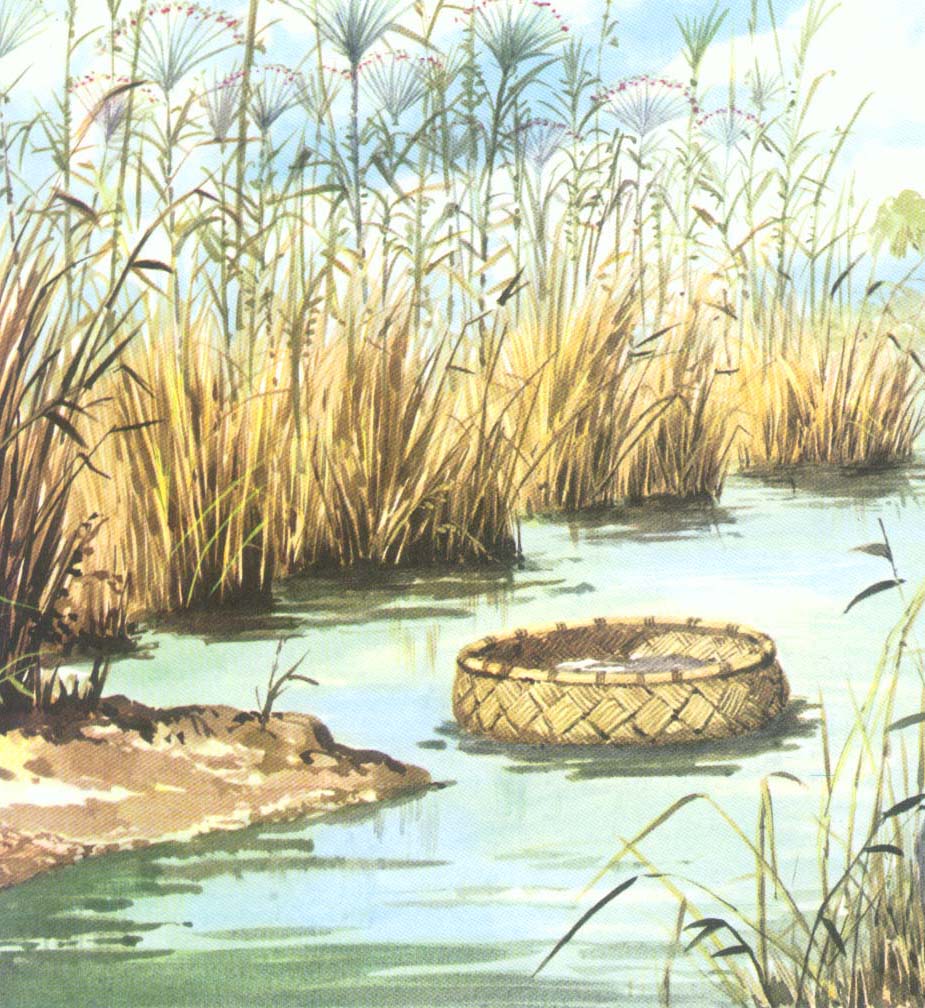
It’s interesting to note the Hebrew word for basket:  tebah (tay-vah).  It’s the same word that’s used to describe the boat in which Noah and the animals floated back in the book of Genesis.  That’s right.  Moses is in his own little ark.  And just as the future of human and animal kind was kept safe in that vessel so long ago, now the future of this child and the people of Israel are dependent on this little miniature ark to keep them safe.

I can imagine Moses’ mother and sister collecting the grasses and reeds they would use to weave that basket.  The care his mother put in to making sure that the strands were pulled together as tight as possible so as to keep the inside dry.  

The speed of her fingers as they worked feverishly to finish the basket by the morning, just in time for the sun to rise over the banks of the Nile so that she could see the silhouette of Pharaoh’s daughter making her way down the bank for her morning bath.

Last week, we heard the lullaby of the mother singing to her son in Love You Forever.  And I wonder if Moses’ mother sang a similar song to him as she placed him in that basket, the water of the Nile River lapping at the hem of her robe:  I’ll love you forever.  I’ll like you for always.  As long as I’m living, my baby you’ll be.

What does it mean to put that which you hold most precious into the care of God’s basket, that tebah, that little ark?  To cast your care into that vessel and set it onto the waters, hoping against hope that what you have placed there will arrive safely? 

I think of African American mothers and fathers whose hearts are always at the water’s edge as their sons and daughters go into the world, worrying that they may be shot dead simply because of the color of their skin. 

I think of parents of gay, lesbian, transsexual or transgender sons and daughters whose hearts are at the water’s edge, worrying that they may be discriminated against, cast out, or endure violence simply because of the person they love.

I think of parents of daughters whose hearts are at the water’s edge as they send their young women to college, worrying that they may be targeted for sexual violence.

I think of the fathers and mothers of children in countries overrun by gangs in places like Honduras or El Salvador, desperate to get their children out of harm’s way, and knowing that torture and death await many of them.


All the family wanted to do was to escape the war in their country.  They, like Moses’ mother, were desperate to survive and did whatever they could to help their children live.  But Aylan, his brother, and his mother did not survive when the boat that was supposed to carry them to freedom capsized.  The image of that little lifeless body is now emblazoned on millions of eyes around the world.  We all stand at the water’s edge.  Will we be like Pharaoh’s daughter and do something – anything – to help a desperate family?  Or will we stand in our palaces, our hearts hardened like Pharaoh himself, impervious to the pain?

At the prayer table downstairs, the card I picked was this one – a mother holding her child, her face drawn down in despair, wanting nothing more for her child than for him or her to be safe, to have a place to live, to be free from violence, to have access to clean water and healthy food, to have freedom to simply live.

Each of you as you came in today was also asked to choose a word or an image on a card that represented for you something that you want to entrust to God in prayer.  Take a look at that card again.  During communion, you will have an opportunity to place that card in the basket as a symbolic gesture of casting your concerns into the care of God. 

We, like Moses’ mother, each stand at the water’s edge, the waters of baptism lapping at our feet, reminding us that while the waters can be unpredictable and do have the potential to be dangerous, they also have the capacity to be cleansing and life-giving. 

Our prayers are so powerful.  They are not magic.  They will not immediately right all the wrongs in the world.  But they are a first step toward aligning our thoughts, and then our actions with the God who weaves herself into the strands of our baskets, holding us, holding our loved ones, holding our prayers in a place of safety.

“You found me,” we’ll be singing in our song.  God will find you, whether you are standing at the water’s edge, or huddled in the basket, or walking down the bank of the river, or standing in a palace built by the labor of slaves.  

God will find you.  And your life will never be the same.

Amen.

Thursday, August 27, 2015

The Challenges of Racism

#elca #blacklivesmatter #racism

(This is the column that I published in our church's September 2015 newsletter.  The column is called "Sunlight from Schade.")

As part of our preparations for the ELCA Youth Gathering, we were asked to do a session on racism with our youth and their parents to help us begin thinking about this aspect of what we would encounter when we went to Detroit.  We worked through the materials and began talking about racial and ethnic stereotypes and the way racism is “baked in” to the fabric of our lives on an individual, interpersonal, social and institutional level.  I have to say, those sessions generated some of the most meaningful conversations I’ve ever had in our church.  While on the surface, it may appear that we are a fairly homogeneous congregation, if you dig just a little, you discover that we are more diverse than you might think.  For example, we have several people of mixed races or African descent in our congregation.  We also have some folks who are LGBTQ, or closely related to someone who is.  The group also discussed our diversity in terms of socio-economics, age, and disability.  So when we talk about “confronting racism” and other forms of injustice, we’re talking about very real people—our brothers and sisters in Christ—who have experienced injustice in a very personal way.

Our ELCA Bishop, Elizabeth Eaton, made an intentional effort to address these very concerns in a recent webcast she did with William Horne II, an African American ELCA member in Florida.  In several public statements, Eaton has called for deep conversations about racism and racial justice, particularly in response to several events in the United States, such as police killings of unarmed black men and women, and the June 17 racially-motivated slaughter of black women and men at Emanuel AME Church in Charleston. “God’s intention for all humanity is that we see the intrinsic worth, dignity and value of all people. Racism undermines the promise of community and fractures authentic relationships with one another. We need to talk and we need to listen, but we also need to act,” says Eaton.

Added Mr. Horne:  “Talking about race and racism is hard work for most of us. Our Christian witness compels us to confront our sinfulness in all forms from within and outside of ourselves. It is more beneficial if we do it together.” You can see the video of their enlightening conversation here:  http://elca.org/webcast. 

In response to a statement and call to action from the African Methodist Episcopal Church (AME), Bishop Eaton has asked ELCA churches participate in a day of prayer and commitment to end racism on Sept. 6.  During worship that day, we will offer prayers specifically addressing the need to confront and root out the hold that racism has on our hearts, minds and actions. 

But it cannot end here.  Racism is a hundreds-year-old demonic force in our country, and we will not be done the work of casting out this evil until our brothers and sisters of color say we’re done.  White privilege has dictated the terms of this “conversation” for far too long.  As a white, middle-age, middle-class, educated, able-bodied, heterosexual female who strives to answer God’s call to lead a Lutheran congregation, I must do my part to listen to the voices of the oppressed, take seriously their calls for justice, call out racism (and all “isms” for that matter) when I encounter it, and encourage the parishioners I serve to do the same.

I hope you will join me in undertaking this difficult but necessary work of critically examining our prejudices, assumptions, and enculturated beliefs in order to humble ourselves before God and our neighbors of color and repent of our collective and individual sins of racism.  God promises that by doing this work together, we will learn what healing looks like for the Body of Christ.

—Pastor Schade


Friday, July 24, 2015

Postcards from Detroit, Part Two: Racism – The Struggle is Real

The Rev. Dr. Leah D. Schade
#blacklivesmatter #racism #riseupelca
(Part One of "Postcards from Detroit: Let's Tell the Rest of the Story" can be found here: http://ecopreacher.blogspot.com/2015/07/postcards-from-detroit-part-one-lets.html )

Prior to my trip to Detroit for the ELCA Youth Gathering with the teens from the congregation I serve, United in Christ Lutheran in Lewisburg, PA, we completed a preparatory session on racism.  We learned about the levels of individual, interpersonal, institutional and structural racism that we encounter in our relationships and in society.  We discussed the term “white privilege” and the stereotypes we have about certain races.  As a seminary student, I had gone through anti-racism training, and as a pastor of Spirit and Truth Worship Center in Yeadon, PA, I had the honor of serving an African American/African native congregation who taught me a great deal about the challenges of racism.  But I encountered something in Detroit that showed me just how embedded my stereotypes are about non-white people.
 
On our walk through center city Detroit one day, my youth and I came upon an open-air plaza where tall tables and chairs were lined up and eleven young black boys and girls sat across from each other playing chess – competitive speed chess, complete with timers.  


These girls and boys were upper elementary and middle school-aged, and they had an adult male mentor with them.  We watched, mouths gaping, as they made their moves, slapped the timers, joked and laughed, and whizzed through their games.  One boy, seeing his opponent make a good move against him, shouted out, “The struggle is real!” And we all laughed together. (For more info on the Detroit City Chess Club:  http://www.detroitcitychessclub.com/chessphotos.html)


As I was taking pictures of their group, one little boy called out to me, “You want to play?”  While I knew how to play chess, we were on our way to the next event for the Gathering, so I had to politely decline.  “It’s okay, I can teach you!” he offered.  It was an “Aww,” moment – but I felt convicted in my soul.

Why is it that we were so shocked to see young black boys and girls engaging in a game that requires incredible mental skills of logic, strategy, pattern-recognition, and intellectual speed?  Did we not think their brains capable of such feats of intelligence?  Did we succumb to the stereotype that black children are only troublemakers and ne’er-do-wells, training for gang life and criminal activity, and incapable of higher thinking skills?  Were we so caught up in the assumptions that black males are lazy, violent and only interested in sports, and girls only destined to pre-teen unwed motherhood, that seeing them peacefully and joyfully engaging in chess just blew our minds?  And did we think them an exception to the unspoken rule that black people simply don’t have the capacity or interest to engage in demanding brain-training activities?

One of the speakers at the Gathering, Marian Wright Edelman, was a Civil Rights activist and is a lawyer who founded the Children’s Defense Fund.  As she spoke, I pictured those young black girls and boys at their chess boards.  And I began thinking about the millions of minds we wasted in this country by relegating them to slavery, then segregation, then the new Jim Crowe, and the ongoing instances of discrimination in education, housing, jobs, ecological racism, and economic access.  Not to mention the growing instances of violence by police and citizens against unarmed blacks in this country. She has fiercely advocated for policies that enhance the lives and educations of America’s poorest children, noting that the economic and racial inequalities in this country actually hinder all of us – not just the ones denied access.  (The video of her full speech can be found here:  https://youtu.be/xVg62VaQL50?t=8115.) 

Yes, chess-playing child, you have taught me.  We all need to be reminded that the minds of black boys and girls are as smart as those of whites.  That they are just as capable of learning and cognitive development as their white counterparts.  And that when we deny them access to education through the myriad of social problems such as inadequate housing, healthcare, nutrition, and the mass incarceration of their parents, we are actually hurting ourselves.  How many potential inventors, scientists, writers, surgeons and artists have we denied ourselves as a nation over the past 400 hundred years by enslaving and shutting out those minds?  Who are the potential engineers, college professors, doctors and well-educated parents and voters we are shutting down right at this very moment? 

In central PA where I live, there is a heated battle over whether or not to allow a low-income housing site to be located in the wealthy, white, privileged, “safe” Lewisburg school district.  Citizens at the meetings blatantly voice their racial stereotypes:  we don’t want “those people” lowering our property values, bringing crime and drugs to our town, and bringing down the test scores of our schools. (See: http://www.dailyitem.com/news/housing-foe-says-penn-commons-may-become-a-crime-riddled/article_62979064-30c7-11e5-bc2c-9f98ab3f786a.html . Also see https://www.facebook.com/ccalewisburg.)

Those people are the chess-playing girls and boys.  By refusing to welcome them and educate them, we are sending away the future of America.  Shame on us.  The struggle is real.