Thursday, August 27, 2015

The Challenges of Racism

#elca #blacklivesmatter #racism

(This is the column that I published in our church's September 2015 newsletter.  The column is called "Sunlight from Schade.")

As part of our preparations for the ELCA Youth Gathering, we were asked to do a session on racism with our youth and their parents to help us begin thinking about this aspect of what we would encounter when we went to Detroit.  We worked through the materials and began talking about racial and ethnic stereotypes and the way racism is “baked in” to the fabric of our lives on an individual, interpersonal, social and institutional level.  I have to say, those sessions generated some of the most meaningful conversations I’ve ever had in our church.  While on the surface, it may appear that we are a fairly homogeneous congregation, if you dig just a little, you discover that we are more diverse than you might think.  For example, we have several people of mixed races or African descent in our congregation.  We also have some folks who are LGBTQ, or closely related to someone who is.  The group also discussed our diversity in terms of socio-economics, age, and disability.  So when we talk about “confronting racism” and other forms of injustice, we’re talking about very real people—our brothers and sisters in Christ—who have experienced injustice in a very personal way.

Our ELCA Bishop, Elizabeth Eaton, made an intentional effort to address these very concerns in a recent webcast she did with William Horne II, an African American ELCA member in Florida.  In several public statements, Eaton has called for deep conversations about racism and racial justice, particularly in response to several events in the United States, such as police killings of unarmed black men and women, and the June 17 racially-motivated slaughter of black women and men at Emanuel AME Church in Charleston. “God’s intention for all humanity is that we see the intrinsic worth, dignity and value of all people. Racism undermines the promise of community and fractures authentic relationships with one another. We need to talk and we need to listen, but we also need to act,” says Eaton.

Added Mr. Horne:  “Talking about race and racism is hard work for most of us. Our Christian witness compels us to confront our sinfulness in all forms from within and outside of ourselves. It is more beneficial if we do it together.” You can see the video of their enlightening conversation here:  http://elca.org/webcast. 

In response to a statement and call to action from the African Methodist Episcopal Church (AME), Bishop Eaton has asked ELCA churches participate in a day of prayer and commitment to end racism on Sept. 6.  During worship that day, we will offer prayers specifically addressing the need to confront and root out the hold that racism has on our hearts, minds and actions. 

But it cannot end here.  Racism is a hundreds-year-old demonic force in our country, and we will not be done the work of casting out this evil until our brothers and sisters of color say we’re done.  White privilege has dictated the terms of this “conversation” for far too long.  As a white, middle-age, middle-class, educated, able-bodied, heterosexual female who strives to answer God’s call to lead a Lutheran congregation, I must do my part to listen to the voices of the oppressed, take seriously their calls for justice, call out racism (and all “isms” for that matter) when I encounter it, and encourage the parishioners I serve to do the same.

I hope you will join me in undertaking this difficult but necessary work of critically examining our prejudices, assumptions, and enculturated beliefs in order to humble ourselves before God and our neighbors of color and repent of our collective and individual sins of racism.  God promises that by doing this work together, we will learn what healing looks like for the Body of Christ.

—Pastor Schade


Friday, July 24, 2015

Postcards from Detroit, Part Two: Racism – The Struggle is Real

The Rev. Dr. Leah D. Schade
#blacklivesmatter #racism #riseupelca
(Part One of "Postcards from Detroit: Let's Tell the Rest of the Story" can be found here: http://ecopreacher.blogspot.com/2015/07/postcards-from-detroit-part-one-lets.html )

Prior to my trip to Detroit for the ELCA Youth Gathering with the teens from the congregation I serve, United in Christ Lutheran in Lewisburg, PA, we completed a preparatory session on racism.  We learned about the levels of individual, interpersonal, institutional and structural racism that we encounter in our relationships and in society.  We discussed the term “white privilege” and the stereotypes we have about certain races.  As a seminary student, I had gone through anti-racism training, and as a pastor of Spirit and Truth Worship Center in Yeadon, PA, I had the honor of serving an African American/African native congregation who taught me a great deal about the challenges of racism.  But I encountered something in Detroit that showed me just how embedded my stereotypes are about non-white people.
 
On our walk through center city Detroit one day, my youth and I came upon an open-air plaza where tall tables and chairs were lined up and eleven young black boys and girls sat across from each other playing chess – competitive speed chess, complete with timers.  


These girls and boys were upper elementary and middle school-aged, and they had an adult male mentor with them.  We watched, mouths gaping, as they made their moves, slapped the timers, joked and laughed, and whizzed through their games.  One boy, seeing his opponent make a good move against him, shouted out, “The struggle is real!” And we all laughed together. (For more info on the Detroit City Chess Club:  http://www.detroitcitychessclub.com/chessphotos.html)


As I was taking pictures of their group, one little boy called out to me, “You want to play?”  While I knew how to play chess, we were on our way to the next event for the Gathering, so I had to politely decline.  “It’s okay, I can teach you!” he offered.  It was an “Aww,” moment – but I felt convicted in my soul.

Why is it that we were so shocked to see young black boys and girls engaging in a game that requires incredible mental skills of logic, strategy, pattern-recognition, and intellectual speed?  Did we not think their brains capable of such feats of intelligence?  Did we succumb to the stereotype that black children are only troublemakers and ne’er-do-wells, training for gang life and criminal activity, and incapable of higher thinking skills?  Were we so caught up in the assumptions that black males are lazy, violent and only interested in sports, and girls only destined to pre-teen unwed motherhood, that seeing them peacefully and joyfully engaging in chess just blew our minds?  And did we think them an exception to the unspoken rule that black people simply don’t have the capacity or interest to engage in demanding brain-training activities?

One of the speakers at the Gathering, Marian Wright Edelman, was a Civil Rights activist and is a lawyer who founded the Children’s Defense Fund.  As she spoke, I pictured those young black girls and boys at their chess boards.  And I began thinking about the millions of minds we wasted in this country by relegating them to slavery, then segregation, then the new Jim Crowe, and the ongoing instances of discrimination in education, housing, jobs, ecological racism, and economic access.  Not to mention the growing instances of violence by police and citizens against unarmed blacks in this country. She has fiercely advocated for policies that enhance the lives and educations of America’s poorest children, noting that the economic and racial inequalities in this country actually hinder all of us – not just the ones denied access.  (The video of her full speech can be found here:  https://youtu.be/xVg62VaQL50?t=8115.) 

Yes, chess-playing child, you have taught me.  We all need to be reminded that the minds of black boys and girls are as smart as those of whites.  That they are just as capable of learning and cognitive development as their white counterparts.  And that when we deny them access to education through the myriad of social problems such as inadequate housing, healthcare, nutrition, and the mass incarceration of their parents, we are actually hurting ourselves.  How many potential inventors, scientists, writers, surgeons and artists have we denied ourselves as a nation over the past 400 hundred years by enslaving and shutting out those minds?  Who are the potential engineers, college professors, doctors and well-educated parents and voters we are shutting down right at this very moment? 

In central PA where I live, there is a heated battle over whether or not to allow a low-income housing site to be located in the wealthy, white, privileged, “safe” Lewisburg school district.  Citizens at the meetings blatantly voice their racial stereotypes:  we don’t want “those people” lowering our property values, bringing crime and drugs to our town, and bringing down the test scores of our schools. (See: http://www.dailyitem.com/news/housing-foe-says-penn-commons-may-become-a-crime-riddled/article_62979064-30c7-11e5-bc2c-9f98ab3f786a.html . Also see https://www.facebook.com/ccalewisburg.)

Those people are the chess-playing girls and boys.  By refusing to welcome them and educate them, we are sending away the future of America.  Shame on us.  The struggle is real.


Thursday, July 23, 2015

Postcards from Detroit, Part One – Let’s Tell the Rest of the Story

The Rev. Dr. Leah D. Schade
#riseupelca #detroit

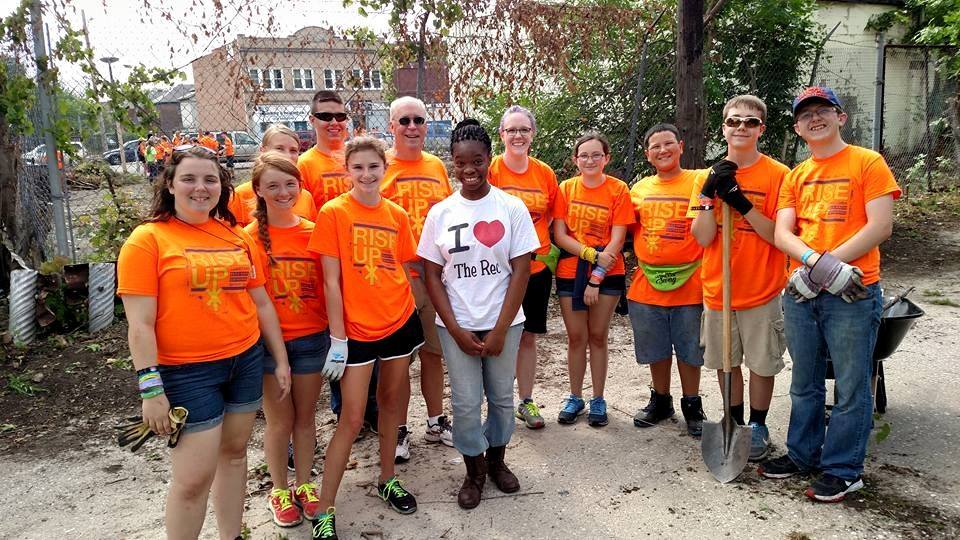
During the week of July 14 – 20, I accompanied a group of youth from the church I serve, United in Christ Lutheran in Lewisburg, Pennsylvania, along with youth and advisers from four other Lutheran churches in our conference, to Detroit, Michigan, for the triennial ELCA Youth Gathering.  We joined 30,000 other Lutheran youth for five days of learning, service, worship, fellowship and fun.  What we saw in Detroit is a very different place than the one consistently portrayed in the media.  Coming from small town, rural central Pennsylvania, our youth felt some trepidation going to a city that has a reputation for violence, poverty, drugs, gangs and general depravity.  However, after walking the streets of downtown Detroit and serving in a HOPE Village community clean-up project in the northwest part of the city, we met the residents, learned about the complexities of this city, and have come back to tell a different story. 
We came . . .


 Yes, the negative things heard about Detroit are true.  
We saw . . .


But what is rarely, if ever reported is that the people of Detroit are welcoming, friendly, warm, appreciative, and joyful – even in the midst of their struggles.  When word got out about these busloads of youth being deployed throughout the city in their orange shirts to clean out abandoned lots, paint park benches, read to children, pack food boxes, and countless other projects, the residents made it a point to come up to us and thank us for the work we were doing.  
We cleaned . . .

Weeded . . .


Clipped . . .


One resident I talked to, upon seeing his neighborhood transformed from trash-filled to clean before his very eyes, said, “This gives me hope.”  
Before . . .
After.


Coming back from Ford Field each night after the spirit-filled concerts and inspirational speakers, we saw local children greeting the parade of singing teens in the streets,


parking attendants dancing for us, 


and residents in high-rises waving and smiling.  What I heard repeatedly from residents who we talked to was this plea:  Please tell the rest of the story about Detroit when you get home. 


The challenges of structural racism, patterns of poverty, educational inequality, and economic misfortunes in Detroit are real, deeply embedded and complex.  But every city, every town faces these kinds of challenges.  The youth in my church reminded me repeatedly that drugs are a problem in their schools, racism is thinly veiled in our community, poverty is a constant for many, and their own neighbors and family members make poor choices when it comes to important life decisions.  They now realize that their circle of “family” has been extended to Detroit.  And Detroiters came to learn that they have more allies in their corner than they ever imagined. 

Most importantly, our youth realized that God is already at work in these supposedly God-forsaken places.  The theme of the Gathering was “Rise Up.”  We saw this resurrectional rising in Detroit and are inspired to continue to do God’s work with our hands here in our own community as well.  


Friday, July 10, 2015

Student Haiku Reflections on The Holy Spirit: Creator of Life

Haiku poetry by the confirmation class
United in Christ Lutheran church, Lewisburg, pa
The Rev. Dr. Leah Schade, pastor

July 2015

The Confirmation students completed their final unit on the Apostle’s Creed with a session on the Holy Spirit.  After reading Bible passages, discussing the Apostle’s Creed, and meditating on the Spirit, we went to the Island at Milton State Park where the students spent time writing haiku poetry about the Holy Spirit. 

Haiku is a form of Japanese poetry that consists of three lines, the first with five syllables, the second with seven, and the third with five.  

Spirit: Fire and Dove
Creator of Life and Church
Upholder of Truth.
-        Amy Danowsky


Fire, Wind and the Dove.
Creating the Life within
And the endless Love.
-        Marianne Murray


Creator of Life
Spiritus creates the Church
Wind, Dove, Breath of God
-        Dalton Shearer


Spirit in the Fire
Three-in-One, the Trinity
Holy bond of Life.
-        Dustin Kemper

Sustainer of Life
Forgiveness and Communion
The Resurrector
-        Amy Danowsky

Children will learn to protect what they love.  Connect youth to the Creation of God and cultivate their appreciation for the power of the Holy Spirit to create new life in them and all around them.

Monday, July 6, 2015

Sermon: Finding Jesus in Our Weakness

The Rev. Dr. Leah Schade
July 5, 2015
Text:  2 Corinthians 12:2-10

(Children’s sermon: Children are given thin sticks and asked if they can break them.  We can break the stick when it’s by itself.  But when we bundle it with a bunch of other sticks – we can’t break them.  Bound together in God's love, we experience power - even in our weakness and brokenness.)

We are at the end of our sermon series “Finding Jesus Finding Us,” and today we’re focusing on finding Jesus in the midst of our weakness.  As St. Paul wrote in his Second Letter to the Corinthians:  “Therefore, to keep me from being too elated, a thorn was given me in the flesh, a messenger of Satan to torment me, to keep me from being too elated.8Three times I appealed to the Lord about this, that it would leave me,9but he said to me, “My grace is sufficient for you, for power is made perfect in weakness.”

What an odd statement:  power is made perfect in weakness.  It seems like a contradiction.  We would think that the phrase should be:  power is made perfect in strength.  But that’s not what Paul said.  He’s talking about the thorn in his flesh (that’s where we get the phrase – a thorn in my side, by the way).  We don’t know what he’s referring to – some kind of physical ailment or injury?  Some ugly growth on this skin?  Or perhaps it’s a weakness for something – some temptation that causes him to give in.  We don’t know.  All we know is that he prayed for the thorn to be removed.  And God’s response is:  “My grace is sufficient for you, for power is made perfect in weakness.”
This week on Facebook, I posed the question:  What is your weakness?  And how have you experienced God’s power in that weakness?  One Facebook responder gave a list of different ways we experience weakness, including:  depression, lack of clarity, financial fear, stress from parenting, and broken relationships.  She said that experiencing weakness feels like “God is closing a door and not opening a window fast enough.”

You’ll see at either end of your pew that there are slips of paper.  I want you to think about what your weakness is and write it on that slip of paper.  Don’t put your name – just write down what your weakness is.  Whether it’s your pride, or a health issue, or your stubbornness, or your addiction.  Just write it down and fold it up tight. 

As you’re doing that, I’m going to ask Mike Mertz to come up and share with you his testimony about where he has experienced God’s power within his own weakness.  Mike is one of the biggest, strongest guys I know. I remember the first time I met him here at church when I came here four years ago – I thought the church had hired a bouncer!  Mike is a trainer and specialist in sports medicine.  The more I've gotten to know Mike over these years, I learned that he has a very deep faith – faith that has been tested by times of weakness.  And he has learned a thing or two about what it means to experience God’s grace and power made perfect in weakness.

[Mike’s testimony: see video for full story. https://www.youtube.com/watch?v=TJbWLwwxqN4&sns=fb  Mike's portion starts at 6:19.  Summary - Mike was a golfer who was prepared to turn professional, but two weeks before he was to start, he broke a bone in his hand, which ended his career before it started.  He was devastated at the time, but eventually followed the path of sports medicine and give thanks to God that he has been able to help so many adults and kids.]

Here’s the thing:  Mike literally experienced a pain in his wrist that was like a thorn in the flesh.  It was a career-ending injury.  He would no longer be able to pursue his dream of becoming a professional golfer.  But through this weakness, God’s power was made perfect in Mike.  He has touched the lives of probably a thousand adults and young people as a sports trainer, and has helped them either avoid injury, or recover from injury.  Mike understands sports medicine on a very personal level, knows the importance of keep one’s body in good shape and playing sports the right way in order to minimize injuries.  God’s power of healing has been made perfect in Mike’s weakness. 

Remember – I’m not saying that God caused Mike’s injury so that he would follow the path of sports medicine.  That’s not how God works.  God is not like a master game player up in the sky, deciding to afflict some people just to achieve a certain outcome, no matter how positive.  If that was the case, it would mean God is arbitrary and manipulative and cruel.  No – God is not up in the sky making things happen.  God is here below, among us, accompanying us no matter what we face, no matter what circumstances arise, and creating something new out of our brokenness. 

When I was a hospital chaplain I had the occasion to visiting a young woman in the oncology wing who was facing a recurrence of cancer. She was very frustrated – just like Paul.  This person had prayed fervently that the cancer would resolve itself.  Lots of people were praying for her, all over the world.  So she had strong confidence that God would keep the cancer away.  So when the test came back positive, and it turned out that the cancer was back, this person was understandably shaken.  She was doubting the power of prayer, her own faith, and doubting God. As I sat with her, I remembered this verse from 2 Corinthians and read it to her – “My grace is sufficient for you.  Power is made perfect in weakness.”  I asked her to imagine a way that God’s power might be made perfect even in her illness.

She thought for a while, then answered:  “Maybe if - no when - I come through this surgery, I can help other cancer patients who are facing the same thing as I am.  I know there is a cancer support group here at the hospital.  Maybe I can volunteer with them, maybe become something like a cancer coach, helping people go through what I’ve experienced.  No one understands cancer better than one who has been through it.”

I thought this was a very wise and faith-filled response.  I don’t know what happened to the woman, because after she left the hospital, my chaplaincy ended.  But I felt certain that God would find a way for that divine power to be made perfect through her weakness. 

That’s what Mike has learned over the course of his life.  Power is made perfect in weakness.  Notice – God did not magically make everything the way Mike wanted it to be after his injury.  But when we walk with each other, help others by sharing what we’ve been through, it’s like bundling these sticks together – there is incredible strength.  Every fault, every sin, every failure, every affliction can eventually be an opportunity to walk alongside someone on the same path, embodying Christ’s presence, compassion and grace.

Here’s what I invite you to do.  As we sing the hymn, I invite you to come forward and make an “offering of weakness.” Put your folded up piece of paper here in this basket – remember, no names.  At the end of the hymn, I will say a prayer over the offering of weaknesses.  We will pray together that God’s grace will be sufficient for you and for our congregation. And that we might, together – like sticks banded together, weak by themselves, but united in strength – that we might experience God’s power through our weakness.

As the Facebook responder wrote:  “When I am weak, He is strong! I lean harder on Him! I wait patiently (okay, maybe not so patiently) but I remind myself of God’s love for me. I remind myself that God is bigger than my problems! That He is Jehovah Jireh, Lord Provider; Jehovah Shalom, Lord of Peace; Jehovah Sabbaoth, Lord of Deliverance! And I have learned when the storm clouds roll, I send my praises up and they break apart those clouds and the blessings come down! Praise is the weapon and I have never seen it fail!"

May God's power be made known to you through your weakness today.  And may we, as a bundle of brokenness and weakness, be a witness to God's power through Jesus Christ.  Amen.


Sunday, June 28, 2015

Reaching for the Hem of the Robe: Plenty of Healing to Go Around

The Rev. Dr. Leah D. Schade
June 28, 2015
Text:  Mark 5:21-43
#marriageequality #blacklivesmatter 

I teach Ethics at Lebanon Valley College.  As the students and I grapple with issues of fairness, justice, and access to resources throughout the semester, they begin to become overwhelmed by the sheer magnitude of problems our society faces.  I remember one student’s comment when I introduced them to the notion of environmental ethics.  “There are too many other problems to worry about,” he said.  “I know environmental issues are important, but I just don’t think we should focus on them when we’ve got our national security to think about and all the other social problems.”
 
Setting aside his assumption that environmental issues and national security are unrelated (because, in fact, they are integrally related [see http://weather.climate25.com/]), what I sensed in his comment, and others shared by his classmates is the fear of scarcity.  That there’s not enough to go around.  If we focus our energy on racial equality, there won’t be enough left for gender equality.  If we focus on marriage equality, there won’t be enough left for economic equality.  If we focus on raising the minimum wage, there won’t be enough energy left to focus on climate disruption.  And so on.  The underlying assumption is that there is only so much justice and healing to go around. 

This is the situation Jesus faced in his ministry every day.  There were so many issues and social problems in first century Palestine – the brutal military occupation by the Roman Empire, the ethnic tension between the Jews and Samaritans, the unequal access between men and women to the Temple and God’s blessings, and the poverty of the majority of the population.  Add to that the hundreds of people who were daily crying out to him for healing – the lepers, the lame, the ones possessed by mental and emotional demons.  It was a time of great turmoil, and there was Jesus right in the thick of it all.

In this story from Mark in particular, we see the conflict of two dire needs – one that has been simmering for a long time, one that has come up suddenly.  Jesus is asked to come to the house of Jairus the synagogue leader in order to heal his little girl who is on the verge of death.  The need is urgent.  He must come now.

But as he makes his way through the crowd, another need makes itself known.  This is one that has been plaguing the woman for twelve years – menstrual bleeding that just won’t stop.  Such a condition makes her a pariah to society because she is considered ritually unclean.  The bleeding is not her fault, but it has drained her resources, her energy and her patience.  There she is in the crowd where she has been ignored, disrespected and disregarded for most of her life.  But suddenly she sees an opportunity for healing – and she grabs it. 

She doesn’t ask Jesus directly.  She doesn’t want to interrupt him on what she knows is a very important mission.  But like the Samaritan woman at the banquet, she just wants a few crumbs from the table.  And so she reaches for the hem of Jesus’ robe – hoping against hope that even a brief swipe of her hand against the fabric that has touched this divine healer’s skin will be enough to give her a modicum of relief. 

That’s all she wanted – some relief after years of suffering.  She didn’t want to draw attention to herself.  She didn’t want to cause a fuss.  But she acted out of desperation after waiting for so long for healing.  And miracle of miracles - she got it!  Instantly she could feel her body returned to wholeness, the bleeding stopped, her energy returned.

But then her plan goes awry, because Jesus halts in his tracks.  He could have just kept going.  Why did he stop?  The healing had already happened, hadn’t it?  Or perhaps the healing was not actually complete.  Because Jesus wants to know who it was that reached out and took some of his power for themselves.

Now the woman is faced with a decision – fade into the crowd as she has always done, or speak up for herself in public?  Certainly she would face admonishment.  How dare she – a woman, a bleeder, an outcast – reach out to him, the Son of God, for healing?  Who does she think she is?

Trembling, but with courage, she comes forward and claims the healing she sought for herself.  Maybe she just doesn’t care anymore – as long as her body is whole again, she can face anything else.  Or maybe the healing itself has revealed to her a boldness and audacity that she had forgotten about.  In any case – she comes forward to face her fate.  Who does she think she is?  A healed women.  She may still feel afraid, but she is choosing to act out of courage.

Who do they think they are?  I’ve been hearing that question a lot recently as I watch the crowd of social issues pressing in on us in the last few weeks. 

Blacks wanting their lives to matter.  Who do they think they are? 
Same sex couples wanting the freedom and right to marry.  Who do they think they are? 
Middle and lower income people wanting access to affordable health care.  Who do they think they are?
Women wanting equal pay as men and freedom from sexual violence.  Who do they think they are?
Minimum wage workers wanting a pay increase that would enable them to support their families.  Who do they think they are?
Citizens wanting clean water and a sustainable atmosphere for the planet. Who do they think they are?

The question is:  who does God think they are?  Jesus gives us the answer.  He calls the woman “Daughter.”  He doesn’t call her:  You female dog.  You uppity Negro.  You abomination.  You low-life.  You scum.  You tree-hugger. 

No - he calls her “Daughter.”  He claims her as his own.  As his own child.  No other human label matters.  Further, he says to her:  Your faith has made you well; go in peace, and be healed of your disease. 

Notice he didn’t say, my healing power has made you well (even though it has).  He said your faith.  Your willingness to reach out for what you needed.  Your trust in me.  Your audacity.  Your boldness and courage.  That is what has made you well.

If the one who is desperate, whose needs have been ignored and pushed aside and belittled for so long; if the one who is longing for a fair and livable wage;  if the one who is reaching out for healing and wholeness, for equality and recognition of their humanity; if the one who is grasping for just the hem of the robe hoping for a modicum of relief – if that one is recognized and healed by Jesus, then can we begrudge any of those individuals or groups who reach for the hem of the robe today? 

The venerable homiletician Fred Craddock once wrote:  "There are many 'meanwhile, back at the ranch' people whose needs are not only very real but whose conditions are worsened by the fact that they have been made to feel that, in a world as sick as ours, they have no right to cry for help.  Many whose lives are small screen, black and white, push through the crowd to touch the hem of His garment, hoping for a little inconspicuous healing,” (As One Without Authority, Parthenon Press, Nashville, TN, 1979; 84).

Not only does the healing happen, but Jesus acknowledges the woman’s dignity, her humanity, her rightful place alongside her brothers and fathers, alongside the ones who are already privileged to have whole and healthy bodies, the ones who already enjoy economic, racial, sexual and geographic privilege.  I think it is safe to say that Jesus wants no less than that for the ones who are today reaching for the hem of the robe.

And that’s all fine and good for the woman, but it doesn’t get at the original problem – the concern that there simply isn’t enough healing to go around.  While Jesus is taking his time to find and talk to this woman, what happens?  The girl, the one whose need is urgent, but late-coming, has died.  All the while Jairus certainly must have been wringing his hands, tapping his foot impatiently, knowing that time was running out.  And it has.  Jesus had to choose, and someone had to lose.  So it would seem that my student is right.  There simply is not enough time and energy and resources to go around.  We have to choose, and someone has to lose.

Only . . . that’s not that way it works with God.  Brushing aside the doomsdayers who have given up, Jesus resumes his mission to Jairus’ house.  “Do not fear.  Only believe.”  The Greek word is pisteo – have faith, grab hold of confidence, reach for the hem of the robe. 

And yet the little girl cannot reach for him – not even a thread of his garment.  So instead, Jesus reaches for her . . . holds her hand . . . speaks to her . . . “Little girl, get up.”  Arise, wake up.  What you cannot do for yourself, I do for you.  My compassion knows no bounds.  There is plenty of healing to go around. 

Najeeba Syeed-Miller, J.D.,Assistant Prof. of Interreligious Education at Claremont School of Theology, spoke at the Academy of Homiletics in 2014, addressing teachers of preaching.  She encouraged us as Christians to preach about taking risks, to talk and listen with confidence.   She said that when we dismember our hearts from our bodies, when we dismember our hearts from each other, we are dismembered from God.  This is what enables and justifies our rationalization of denying healing and wholeness to our neighbor, to our enemy, to our planet. 

But healing comes when we practice mercy toward others and ourselves.  “God is the full manifestation of justice, beauty and power,” she said.  “Mercy implies a pain-inducing empathy that lays hold of the compassionate one; moves them to satisfy the needs of the one needing mercy.  The Divine has an infinite capacity for experiencing pain, and thus an infinite capacity for mercy and healing.”  Expanding our hearts extends mercy to others.  Mercy is the road to justice – for the woman, for the girl, for people of color, for the poor, for marriage equality, for the planet. 


And for you.  The hem of Jesus’ robe is as close as the drop of oil we will swipe across your brow.  Reach for the hem of the robe.  And if you know of someone else in need of healing, reach out on their behalf.  Bring Jesus to them, as Jairus did for his daughter.  As we offer healing prayers for each other, right now, do not think yourself unworthy of Jesus’ healing.  There is enough healing to go around.  Reach for the hem of robe.  Amen.