Thursday, June 26, 2014

“But how can I protect the world if I can’t kill anybody?”

Conversation with a 7-year-old boy about the myth of redemptive violence

The Rev. Dr. Leah Schade

Last night our family watched The Boy in the Striped Pajamas, a film with the brilliant young actor Asa Butterfield who plays the 8-year-old son of a Nazi commandant assigned as the director of a German concentration camp.  

He moves his wife, daughter and son with him to a heavily guarded house in the woods beyond the camp.  The son, Bruno, sees the camp from his window and thinks that it’s a farm, wondering why the farmers all wear striped pajamas.  Bored without any playmates, Bruno sneaks out of the guarded compound to explore the woods.  He comes to the far side of the camp, surrounded by electrified barbed wire, and sees a boy wearing striped pajamas crouching behind a pile of rubbish.  The boy is Schmuel, and the two strike up a conversation and form a friendship through the wire.

Bruno hears his father, mother, sister and tutor repeat the “party line” about the evil of “the Jew,” the crimes Jews commit, how they are less than human, and are responsible for the ruination of the German people.  He cannot reconcile this propaganda with the Jewish man he comes to know who works in their kitchen and heals his injured knee after a fall.  His confusion is further compounded by the friendship he has with Schmuel. 

“But not all Jews are bad are they?” Bruno asks his tutor.  “Well, if you should find a good Jew, I should think you are the greatest explorer in the world,” the tutor winks.

Without spoiling the ending of the movie, I will say that, given the foul smoke that floats over the compound periodically, it is not surprising that the movie ends with death.  Who dies and how it occurs are particularly gut-wrenching and heartbreaking.  My children melted in tears at the end of the movie.  My son, especially, had incredible difficulty accepting not only the ending of the movie, but the fact that it was a “true story,” in that the Holocaust did indeed happen, and that approximately 6 million Jews and other “undesireables” were murdered.

It was the conversation with my son at bedtime that was most disconcerting, however.  Benjamin is seven, and an avid lover of superheroes.  I try ardently to limit his screen time, boundary his “fighting games” on the computer to one day a week, and ban all toy guns from the house.  But he insists that he must learn to fight so he can “kill the bad guys and protect the good guys.”

Here is an excerpt of our dialogue after the movie:

Ben: See that’s why I have to be a superhero so I can kill the bad guys like the Nazis.

Mom: But how will you know who is really a bad guy?  Remember in the movie they kept telling Bruno that Jews were the bad guys . . . but were they really?

Ben: No.  But that’s why I will have my Spidey-sense so I can tell who the bad guys are.

Mom:  But remember, Spiderman is fiction.  The Holocaust really happened.  There weren’t any superheroes in this movie were there?

Ben:  No.

Mom:  Well, actually, you know who the superhero was?  Bruno.  He helped Schmuel by bringing him food and being his friend.  That’s what Jesus tells us to do – help those who are in need. 

Ben:  But the Nazis killed all those people!  I have to be a superhero so I can kill the bad people.

Mom:  But remember what Jesus said.  Those who live by the sword die by the sword.  Killing people is not what we’re supposed to do.

Ben:  But how am I supposed to protect the world if I can’t kill people?

Mom:  Here’s what Jesus taught us.  As soon as you kill the bad person, you know what happens?  The badness comes into you.  Killing the bad person makes you a bad person too.  Remember what happened to Jesus – he was killed by the bad guys.  But did he kill them back?

Ben:  No.

Mom:  We have to work on helping people, not killing people.

Ben:  But, Mom, you don’t understand.  I’m going to be like Peter Parker.  I’m going to kill the bad guys at night and during the day I’m going to help people.

Mom:  *Sigh* 

What do you think, dear reader?  With all my reading of Walter Wink and Martin Luther King, Jr., John Howard Yoder and William Stringfellow, it all comes down to a 7-year-old wanting to protect the world and seeing the best option as using the very violence that threatens to consume him with its lures and lies.  Pax Romana.  Pax Benjamin?  Peace through violence.  How to help an elementary-aged concrete thinker growing up in a patriarchal culture awash in the myth of redemptive violence understand the nuances of peace through creative, subversive nonviolence? I invite your suggestions.

Lutherans Call for Repeal of “Fracking Loopholes” - Press Release

UPPER SUSQUEHANNA SYNOD, ELCA
NEWS RELEASE


Contact:       Chad W. Hershberger, Director of Communications
                    Phone:  (570) 713-5826               E-Mail: news@uss-elca.org

The Rev. Dr. Leah Schade, Task Force Member
Phone:  (610) 420-6861 (cell)      E-Mail:  jimleah@aol.com


For Immediate Release:  June 26, 2014


Lutherans Call for Repeal of “Fracking Loopholes”

SELINSGROVE— On the recommendation of a bipartisan task group, the Upper Susquehanna Synod Assembly of the Evangelical Lutheran Church in America (ELCA) voted on June 20, 2014, to call for all environmental and public health exemptions on shale gas and oil drilling and its related processes, known as the “Halliburton loopholes,” to be repealed and all processes related to shale gas and oil extraction and processing to be subject to the Safe Drinking Water Act (1974), the Clean Air Act (1990) and Clean Water Act (1972). 

The task force was created as a result of action taken at the Synod’s 2012 assembly directing the group to undertake a comprehensive assessment of the justice issues surrounding the natural gas industry.  The resolution came as a result of two years’ worth of research, field work, and discussion by a diverse group of individuals, appointed by The Rev. Bishop Robert L. Driesen, representing opposing viewpoints on the issue of hydro-fracking.

“Our task force was made up of scientists, professors, pastors, teachers, and lay leaders in the church, as well as individuals who actually work in the shale gas industry or are supportive of it.  Some of us would like to see a total ban on fracking.  Others think it can be done safely with proper regulation.  The fact that we were able to come to the table and engage in civil, bipartisan moral deliberation about this issue and offer a recommendation for the larger church is very important,” said The Rev. Dr. Leah Schade, member of the task force.  “At the very least we could agree that the loopholes created for the industry exempting it from the established laws protecting our water, air and public health are unjust and need to be repealed,” Schade said.

Schade noted that this task force provides a model to other religious bodies as well as civil society for bringing people together across ideological lines to engage in robust ethical debate about controversial issues and arrive at some consensus for the common good.

The task force also provided a report that offered guidelines for approaching shale gas and oil drilling based on biblical and Lutheran theological values, as well as materials and resources to help people understand and interpret the abundance of information about the shale gas and oil industry, pro and con, that continues to grow and change almost daily.  Those resources can be found at http://www.uss-elca.org/for-congregations/fracking-resources.

A copy of the task force’s final report and resolutions will be sent to the Secretary of the US Department of Energy and the Director of the US Environmental Protection Agency, the PA Department of Environmental Protection, local elected officials, Governor Corbett, and other ELCA Synods within the Marcellus and Utica Shale region.


The Upper Susquehanna Synod, headquartered in Lewisburg, PA, is one of 65 synods of the Evangelical Lutheran Church in America.  The synod is made up of 130 congregations in Clinton, Columbia, Juniata, Lycoming, Mifflin, Montour, Northumberland, Snyder, Tioga and Union Counties.  For more information on the synod and its congregations, visit www.uss-elca.org. 

Sunday, June 15, 2014

Sermon: La Lengua de Dios (The Language of God)

Pentecost Sunday
United in Christ Lutheran Church, Lewisburg, PA
The Rev. Dr. Leah D. Schade, PhD
Text:  Acts 2

When is the last time you encountered someone who spoke a different language from you?  It happened to me just this past week.  It was my turn to work the concession stand at my son’s baseball game.  Two other people were there.  One was Nick who was working the grill.  The other was Maria, who spoke with a Hispanic accent.  The two of them had worked together before and had a teasing rapport between them.  He would pronounce her name with an exaggerated accent, or sing her name with the notes of West Side Story’s “Maria.”  And she would laugh and tease him right back.  At one point she called him loco, which means “crazy.”  He said, “I’m just a little crazy.  How do you say that in Spanish.”  I offered:  “Locito?”  Maria turned and looked at me with wide eyes.  “Hablas Espanol?”  Do you speak Spanish?  I said, “Un poco, un poco.”  Just a little.  I had taken Spanish in high school and college and remembered just a little from those days.
 
The rest of the evening we tossed around different words, Spanish and English.  Nick would ask, “How do you say French Fries in Spanish?”  I said “Fritas?”  Maria corrected me:  papas fritas.  Fried potatoes.  I learned that Maria was from the Dominican Republic and how she came to be in our country with her three boys.  Even though my son and hers were on different teams, we cheered for them. Whether they hit the ball, struck out, caught the pop fly or missed the ball, they heard us cheering for them in English and Spanish. 

I can just imagine how it must have felt for the pilgrims gathered in Jerusalem for the Jewish festival of Shavuot, commemorating the giving of the Law on Sinai to the people of Israel, each of them speaking their own foreign language and coming into the city hearing this cacophony of languages.  It must have been very disconcerting for them, the way it must have been for Maria and her family when they first came to America.  Coming through the airport hearing not just English, but so many other languages, not knowing where to go or what to do, until they found someone who spoke un poco, just a little Spanish to help them find their way.

Imagine being one of those pilgrims coming to Jerusalem where the official language would have been Hebrew or Aramaic, and with all those foreigners, it would have been very confusing.  But then they saw a gathering of people with tongues of fire over their heads, and a wind blowing all around them.  They couldn’t figure out what is going on until they heard one of those men speaking their language and their ears perked up.  And they listened to the disciple talk about Jesus, Jesus, Jesu Criste, and the love of God.  What a wonderful feeling it must have been to go from being discombobulated in this foreign land to hearing someone who spoke their language. 
 
I had an interesting discussion with a friend of mine this week about the ongoing debate in this country on whether immigrants wanting citizenship should be required to know the English language.  There are good arguments on both sides of the issue.  Some say we should respect the culture and language of the immigrant and let them speak their own language.  Others say that because English is the official language, they should be required to demonstrate a basic level of proficiency before being granted citizenship so that they can function as citizens in this country.  I don’t claim to have proficiency in that area of government policy, nor do I have an answer to that ongoing debate.  But here is what I do know:  in God’s neighborhood there is no language requirement.  The miracle of Pentecost is not that the Holy Spirit enabled everyone to speak one official language, but that the disciples were given the ability to speak in a language other than their own.  They were able to make a connection with someone with whom they would never have made a connection otherwise. 

We have so many different languages in our world today.  There are approximately 6900 languages—nearly 7000 ways to proclaim God’s love in this world!  These are all ways that we can be proclaiming God’s love for people in a language other than our own.  And where did all these languages come from?  Remember the story of the Tower of Babel in Genesis Chapter 11, how humanity had become so proud and arrogant that they tried to build a tower up to the heavens.  And they all spoke one language.  Apparently there is something about having one language that leads a nation to feel superior, to lose their sense of humility before God, so much so that God confused the language of that civilization and scattered them across the face of the earth.
 
Isn’t it interesting that apparently God thinks it’s a good thing that there are different languages among human beings?

Have you ever tried to learn another language, taken a course in school or online?  It is quite a humbling experience.  You feel awkward and silly when you try to say these words that feel so different on your tongue.  If you’ve ever encountered someone who speaks a language other than your own and you make the effort to try to communicate with them, it takes a certain level of humility and humbleness to put your security in your language aside and say, I want to try to talk to you and listen to you on your terms.  I want to learn how they say things, how they put their thoughts together, how they experience the world and how they express themselves.  When you learn how another person speaks, you start to learn how they think; you open your mind to another way of viewing the world.  It takes a lot of effort, but when you humble yourself and try to learn un poco, just a little of another language, it tells the other person, I honor who you are.  I honor who you are as a Child of God.  And I honor God by trying to learn un poco, just a little of your language. 

When Peter talks to that crowd of 3000 gathered on the day of Pentecost, he quotes the prophet Joel in saying, “Your young people will see visions and your elders will dream dreams,” as an indication that the Holy Spirit has come upon the people.  This week I posed the question on Facebook if anyone has had any dreams or visions for our church.   Kathy Guffey shared with me a dream she had a few weeks ago.  She was in our church on a Sunday morning, and the sanctuary was packed with people.  The pews were so full that people had to stand in the aisles.  In her dream, it wasn’t a special occasion like a funeral or a wedding or a holiday.  It was just a normal Sunday morning.  But she said she looked around with her jaw dropped, just amazed that so many people were at church. 

As a pastor, I got very excited that maybe the day is coming when this dream becomes reality.  But as I was reading this text from Acts, it reminded me that if God were to bless our church with that kind of Pentecost moment, it would mean that there would be people in this sanctuary who look different than us, have a different skin color, speak a different language. When that time comes in our church, it will mean that things are changing and I will have to converse with someone who comes from a different family than I do, or a different country than I do.  I began to ask myself, are we as a church ready for that vision to become a reality in this congregation?

I’d like you to ask yourself that same question this coming week:  Are we ready for the Holy Spirit to come into our church and ask us to be welcoming in a new way?  I’ve often thought that if churches really want to grow, they should determine what is the language—other than English—that is most commonly spoken in the community.  And then offer classes for their members to learn that language, so that they can, like the disciples at Pentecost, be able to speak in la lengua de Dios, the language of God. 
 
There is something about la lengua de Dios that translates into all other languages.  Don’t be surprised if, in the coming weeks and months, you start to encounter people who want to know God, who are seeking Jesus, who want to encounter the Holy Spirit, and come to you, perhaps completely by surprise, and ask, in essence, Hables la lengua de Dios?  Do you speak the language of God?  And if that happens, you’ll be able to say un poco, just a little.
 

That’s all it takes – a little flame, a little courage, a little spark of welcomeness, a little bit of humility, a little breath of the Holy Spirit, and a little heart open to the greatness of God who has a vision of God’s entire neighborhood filling our churches in love to speak la lengua de Dios.  Amen.

Friday, May 23, 2014

Rainbow Garden - A Blessing of Promise and Promise of Blessing

I am a huge fan of Richard Louv's book Last Child in the Woods.  He argues that in order to save our children from "nature-deficit disorder" we need to get them unplugged from electronics and outside to play, get dirty, explore, and fall in love with the natural world.  The end of the book includes a list of 100 creative and simple suggestions for getting children engaged with nature.  One of them includes having them plant a garden. 
 
So when my 10-year-old daughter Rachel announced that she wanted to "redecorate" the weed-patch around the front of our house, I was thrilled.  She has been planning for weeks to create a "rainbow garden" around the steps of our front stoop.  Her 7-year-old brother Benjamin also wanted to be included in the work. Today we went to the local country store and bought flowers in all colors of the rainbow.  And they discovered the wonderful aroma of cocoa shell mulch!  "Smells like chocolate!" they exclaimed when they sniffed the bag.  They couldn't wait to get started.

I warned them that it would be hard work - all the digging, pulling weeds and mulching.  They assured me they were up to the challenge.   So we brought out the spade, trowel and diggers.  We spent an hour on just a 6-cubic-foot area taking turns pulling up the stubborn weeds, turning over the clumps of dirt, and smoothing the loosened soil.  We discovered a world of grubs, earth worms and ants amid the labyrinth of roots and rocks.  Eventually the ground was ready to receive the new plants.  Rachel placed them in appropriate spacing, carefully thinking through size and color.  I taught her how to dig a hole just the right size, how to turn over the potted flower, gently tap and squeeze it from the bottom, loosen the roots and set it in the ground.  We nested the plants in their new home.  Finally it was time for the spreading of the cocoa mulch.  They were tempted to chew on a few pieces, it smelled so chocolatey!
 
They were thrilled with how they had transformed the weedy area into a place of beauty that stimulated all the senses.  Just as we were finishing up, a light rain began to fall.  As we took the tools back to the garage, I remembered how just a few weeks ago we had taken these very items to church for Creation Care Sunday.  We placed them on the altar and the congregation blessed them, along with seeds, soil, and water.  Now these same recipients of blessing had returned the favor!


As I walked back out of the garage, I saw a rainbow appear in the distance, my son pointing excitedly. 

There was the arc of water and light refracted into the very colors we had just planted in our rainbow garden.  Coincidence?  If so, a blessed one.

Tags:  children, gardening, nature-deficit disorder, rainbow, creation-care

Thursday, May 15, 2014

Talkin' Turkey

The joys of serving in a rural congregation: inviting local turkeys to church

http://www.youtube.com/watch?v=5zRxdqYLPSU

Ecotheological Commentary: Fifth Sunday of Easter, Year A

Readings for Year A -- 2013 - 2014
Care for Creation Commentary on the Common Lectionary by Leah Schade

Fifth Sunday of Easter in Year A

Acts 7:55-60
Psalm 31:1-5, 15-16
1 Peter 2:2-10
John 14:1-14

“Come to him, a living stone, though rejected by mortals yet chosen and precious in God’s sight, and like living stones, let yourselves be built into a spiritual house,” said Peter in his letter (1 Peter 2:4). What does it mean to be a living stone? How can a stone be alive?

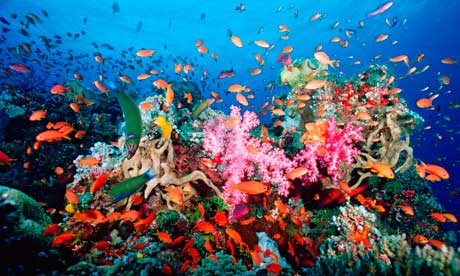
Time magazine recently featured an article about a global effort to photo-document and study coral reefs using state-of-the-art technology (Bryan Walsh, "Ocean View." Time, April 14, 2014). According to the article, about one-third of everything that lives in the ocean lives in a coral reef. Coral is a living organism, even though at first glance it just looks and feels like colorful rock formations.

We might say that coral is like a living stone. “Corals are tiny invertebrates that exist in symbiosis with photosynthetic single-cell algae called zooxanthellae, which live inside the coral’s tissue. (The zooxanthellae provide food to the coral by converting sunlight into energy.) Corals build up hard exoskeletons made of layers of secreted calcium carbonate, which form the reef” (p. 43). The structure is sturdy and yet porous, allowing water to flow through it, absorbing nutrients, housing microscopic life forms. Coral reefs provide habitat, food and spawning grounds for countless species of fish and ocean plants. “In a healthy reef, you can see everything from tiny gobies to predatory sharks swimming amid a network of coral as intricate as a medieval cathedral” (p. 43).
Coral reef near Fiji
Seeing images of these coral reefs brings to mind Jesus’ metaphor for the dwelling place of God: “In my Father’s house there are many dwelling places” (John 14:2). What better way to think about the infinite hospitality of God than to compare it to a beautiful stretch of coral reef hosting so many different life forms! Psalm 31 also reinforces the imagery of God as a sanctuary of rock, strong and protective—similar to the coral reef that hosts a dazzling array of life-forms. “In you, O Lord, I seek refuge . . . Be a rock of refuge for me, a strong fortress to save me. You are indeed my rock and my fortress” (Psalm 31:1, 2-3). The preacher with access to Powerpoint and a screen for worship services may want to project images of coral reefs so that congregants can have these colorful cathedrals in mind as they make the connection between God as sanctuary and rock and Jesus as living stone.


For some churches, May 18 is the day to celebrate Volunteer Recognition Sunday. It is a time to recognize the infinite variety of gifts that each of us brings to the church. We might think of the church as a beautiful coral reef, playing host to so many different individuals and families, an entire ecosystem of faith. Each person has something to contribute to the coral reef of the church. And as a spiritual house of living stones, we each are nurtured by this community, this ecosystem of faith. 

But like the coral reefs in our planet’s oceans, church ecosystems are sensitive to systemic and environmental conditions. The Time article listed overfishing, coastal overpollution and development, global warming and ocean acidification as all having detrimental effects on our oceans’ coral reefs. 
Seventy-five percent of the world’s reefs are threatened. In some locations coral cover has dropped from 80% to 13% over the course of the last twenty-five years.
 
A parallel can be seen in the state of our churches as well. The ecosystems of faith that used to thrive in our society are now finding the conditions around us to be increasingly hostile to the life of the church. Secularization, competition for parishioners’ time, the “pollution” of Sabbath-time by commerce, the growth of “the nones” (folks who indicate adherence to “no religion” in surveys), and the perceived irrelevancy of churches and faith to growing numbers of people are all having detrimental effects on our churches.

What many do not realize, however, is just how valuable the church is to society. The same is true for coral reefs which often go unrecognized for just how much they contribute to our food supply, our economies, and even our medical treatments. Similarly, the church throughout history to the present day has been responsible for much good that most people take for granted. Charity toward widows and orphans, hospitals, public education, the abolition of slavery, the Civil Rights Movement, not to mention the raising of children with strong moral and ethical values, have all had their origins in churches and other houses of worship, and have had a profoundly positive impact on human society over the centuries. Today, churches contribute much to their communities and society in general by addressing poverty and assisting the poor, responding to natural disasters, providing relief to refugees, advocating for society’s most vulnerable citizens, providing counseling and spiritual direction, distributing food and clothing, and providing leadership and resources for justice issues. Too, some of the greatest leaders lifting up and inspiring humanity’s highest ideals have arisen from churches.

The Time article noted that public attention to the plight of coral reefs has suffered because these underwater kingdoms are not easy to see. Very few people ever get to swim amid coral reefs. And there hasn’t been much photo-documentation of these fragile ecosystems. That’s one of the reasons the new 360-degree cameras they are using to photograph the ocean floor are so important (similarly to the way Google Earth has shown us the surface of our planet in astounding ways). Oceanographers have come to recognize the truth of a familiar adage: we will not save what we do not love. Thus they are doing their best to help us fall in love with our coral reefs so that as a human species we will take steps to preserve what is left.

Churches, too, have suffered from lack of visibility and accessibility. Very few people in society come into our churches—swim amid our coral reefs, so to speak. That’s why it’s so important to tell people what goes on in our churches, what great work we do to serve local communities and the larger society. I’ve often mused that churches need to hire publicity directors and public relations experts so that, like the oceanographers who bring these images of the reefs to light, the contributions of our churches can be highlighted in our communities. People will not save what they do not love. We should help people to fall in love with our churches, even if they do not attend them, so that they will come to cherish the incredibly valuable “ecosystems of faith” in our society and communities.

In the sermon, the preacher might show and pass around pieces of coral. Let them feel the strength and texture of the “living stone.” Let them see the tiny holes where the algae live. Let them imagine their church as modelling what God intends for the Peaceable Kingdom—a healthy, beautiful, thriving, protective—and protected—ecosystem that welcomes a stunning diversity of life that benefits the entire ocean of human and planetary life.


More ecotheological commentaries for upcoming lectionary readings can be found at http://www.lutheransrestoringcreation.org/

Monday, May 5, 2014

Ecotheological Commentary: Fourth Sunday of Easter, Year A; Good Shepherd Sunday

Fourth Sunday of Easter in Year A
Acts 2:42-47
Psalm 23
1 Peter 2:19-25
John 10:1-10

Good Shepherd Sunday, as this day is sometimes called, provides multiple points of entry for an ecotheological perspective. In John 10:1-10 Jesus refers to himself both as a “good shepherd” and also as the gate by which the sheep enter into safe pasture. 1 Peter 2:25 compares those who follow Christ to sheep who had gone astray but are now safely in the care of the shepherd Jesus, “the guardian of your souls.” Psalm 23 begins, “The Lord is my shepherd . . .” One only has to say those first five words, and almost everyone in church can join in reciting this most precious psalm.

We are no longer an agrarian nation. Most of us don’t know any sheep herders personally. But at the time when this psalm and the other passages were written, herding sheep was a common profession. Sheep are not the brightest animals on the farm. They have to be led where you want them to go. It is up to the shepherd to find suitable pasture for the sheep to graze. And the shepherd must find water for them. Not just any water—but still water, so that the sheep won’t be swept away by currents that are too fast for them. When we think of this image of water, as Christians, we can’t help but think of the baptismal waters when we hear these words. In the still waters of our mother’s wombs we were created. In the still waters of the font we were baptized Children of God. And this water sustains us all our lives.

For those of us with a Type A personality driven to hard work, we actually have to be led to places that replenish our spirit. Green meadows and still waters are ideal places to do just that. Only by reconnecting with nature can our souls be restored. God knows that, and leads us down those paths... 

Read more:  http://www.lutheransrestoringcreation.org/the-fourth-sunday-of-easter-in-year-a