Sunday, April 21, 2013

Earth Day Sermon: Falling Off the Bike

ECOPREACHER HAS MOVED TO PATHEOS.COM!


For this Earth Day sermon, an 11-year-old’s ill-fated bike ride offers valuable lessons for this time of ecological crisis.  

Read the sermon here:

Tuesday, April 2, 2013

Echoes of the Easter Miracle


Sermon – The Rev. Leah Schade
Easter Sunday, March 31, 2013
The Youtube video of this sermon is available for viewing here:  http://www.youtube.com/watch?v=hUb2QkcwaeM&feature=em-share_video_user

Most of you have already heard the story.  The group of loved ones gathered on that morning to say their goodbyes.  A terrible force of destruction had overcome the man they loved.  They had seen his body ravaged beyond repair.  He had suffered greatly through no fault of his own. And now they just wanted to entrust him to God and release him to death.

But when they arrived to see him, they were told the shocking news – he is alive!  Somehow, by some miracle during the night, a change had happened.  There was no need to say good-bye now.  The group who had gathered couldn’t believe it.  They had to see him with their own eyes. 

And when they entered the hospital room – there he was.  The swelling in his face, hands and feet that had made him unrecognizable was now gone.  The pale color and coldness of death that had enveloped his skin was replaced with the healthy blush of warmth and rosy cheeks.  The machines that had surrounded his body just two days before, filtering his blood through constant dialysis, pumping him full of medicines to keep his heart going and fight the infection, were all disconnected.  All that remained was the ventilator for his breathing, and even that was becoming unnecessary as he was beginning to breathe on his own.  We had gathered to say good-bye to Richard Huff.  But – surprise! – saying good-bye was no longer an option.

This was the closest I have ever come to understanding how the women at Jesus’ tomb might have felt on that morning over two thousand years ago.  When you have your mind set on one direction, steeled yourself to do the ritual,convinced yourself that you are doing the most loving thing you can do given the tragic circumstances, you even start making plans for going on without the person.  But then you hear the unexpected, impossible news that he is no longer on the brink of death, but has, in fact, made a miraculous recovery overnight.  Well, it’s an emotional rollercoaster to say the least.

For those of you who have never met Richard Huff and have not heard about what happened to him, he is a member of our congregation who suffered from a house fire nearly three weeks ago. He was life-flighted to Lehigh Valley Burn Center in Allentown with severe damage to his lungs, exacerbated by his chronic asthma.  It was thought he would recover in a few weeks, but suddenly his body began to deteriorate to the point that his kidneys had failed, his blood pressure was bottoming out, his liver enzymes were escalating, he was not absorbing nutrition, his lungs were overcome with pneumonia and his body was in sepsis.  It quickly became apparent that the only things keeping him alive were the machines surrounding his body on all sides, beeping and clicking, pushing air in and out of his lungs, filtering his blood.  Richard had a living will clearly stating that he did not want his life prolonged in such a way. 

So last Wednesday, four of us gathered around Rich’s bedside – Alice Ann Snyder, Alice’s friend Beverly, Rich’s daughter Becky, and me.  He had been unconscious for nearly two weeks since he had been put on the ventilator.  After listening to the doctors and nurses explain his condition to us, we agonized over what to do.  After much prayer, silence, and open conversation, we decided that we needed to talk to him directly.  So we came alongside him and spoke to him, not even sure if he could even hear us.  But we told him what had happened with the fire and what was happening with his body.  We told him that in two days we were going to gather his family for a prayer service to commend him to God and then honor his wishes to end treatment.  But said to him, “If this is not what you want, you need to find some way to let us know.  And we’re were praying for God’s will to be done.”

Two days later, ten of us came to the Burn Center expecting to do a service of commendation.  Instead, we were told that during the night Richard had dramatically improved.   The nurses who worked day and night to keep Rich going would not consider themselves angels.  But when they shared the news that morning, they might as well have been clad in glorious white robes with mighty wings sprouting from their backs!  Today Richard is no longer on dialysis, all his vital signs are stable, he is breathing on his own more and more, and he is beginning to open his eyes. 

 The medical explanation is that his adrenal gland had not been producing cortisol which was necessary for the chemical reactions needed for his bodily functions.  As an asthma patient, his body was used to the medicines that he used constantly for his breathing, and was apparently going haywire without it ever since the fire.  So they took a chance and tried “jump-starting” his adrenal gland.  There was no guarantee this would work because so many other bodily functions had failed.  But this started a chain-reaction that caused a dramatic improvement.

As I wrote in an email to the congregation, “As people of faith, we call this a miracle!  While the outcome of all this is still uncertain, and Rich is not out of the woods yet, the speed of this turnaround has been amazing.  Overnight, he went from being on the brink of death to being on the road to recovery.  There is still a very long road ahead for him, but he has apparently made his wish clear, and God’s will is obviously being done.”

Even to those who might normally be skeptical about these kinds of things, the word “miracle” is the term most often used when talking about Rich.  A miracle is defined as “an extraordinary event manifesting divine intervention in human affairs, an extremely outstanding or unusual event.”  Time and again as I’ve talked about this event with people, they’ve shared with me stories of other miracles that have happened in their lives.  And Rich’s story helps to affirm their faith that God is real and cares and works miracles, even today.
 
But one person shared something different with me.  She shared with me the story of when her daughter died and there was nothing that could be done to save her.  Even though it happened decades ago, the memory and pain of what had happened was as real as if it were just last week.  And her tears made me pause, in the midst of celebrating Rich’s miracle, and ask – but what about those for whom the miracle did not happen?  What about those who suffer tragedy and experience no surprise of joy?  What does Jesus’ resurrection mean for them?

And then I thought more about this woman.  Despite her grief, she found the strength to get up the next morning, and the morning after that, and every morning since that terrible day when her daughter collapsed in her arms.  She and her husband continued to raise their other two children.  They continued attending church, despite an event that would make most people want to curse God and abandon their faith.  But Sunday after Sunday she is here, serving her church, reading her Bible, hugging little girls who remind her of her own daughter at their age. 

And it dawned on me.  There was a miracle after all.  Because she is still here, she kept going, she did not lose her faith, and she believes as strongly in the power of Jesus’ resurrection as Rich Huff does.  What I began to realize is that there are different kinds of miracles.  Some of them come upon us suddenly, unexpectedly, overwhelming us with surprising joy.  And some of them unfold slowly, over days and months, in and out of years, like the petals of a slow-blooming flower opening up over time.  Like a butterfly whose chrysalis is falling away to reveal the miraculous new creation inside.
God’s power to heal, to forgive, to sustain, to restore is not limited to one morning two thousand years ago in a garden outside Jerusalem.  God’s power shown to us so clearly on that day through the resurrection of Jesus is meant for your life, right now.  It’s meant for our church, right now.  It’s meant for our earth right now.  It’s meant for everyone right now. 

You may feel like you are still locked in a tomb that is sealed with a stone that can never be moved.  But it may be that you are at the center of the bud at the center of the cocoon, and it is beginning to open up very slowly all around you.

Christ is risen.  He is risen indeed.  Hallelujah!


Sunday, March 24, 2013

Sermon: Palm Sunday, Were You There?


The Rev. Leah D. Schade
Palm Sunday, March 24, 2013

Were you there?  That's what we'll be singing later in the service.  Were you there when they crucified my Lord?

The most obvious answer is, No, of course I wasn't there.  That happened over 2000 years ago.  None of us were there.

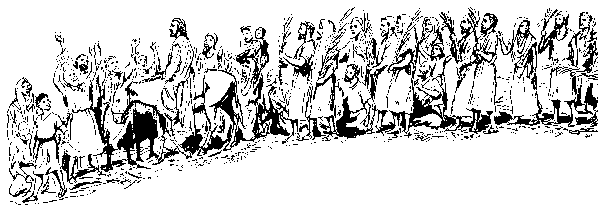
And yet, here we are telling the story again, just like we do every year.  We begin with our palms lifted high, singing "All Glory, Laud and Honor," our voices echoing those of the crowds gathered outside of Jerusalem waving branches, spreading their cloaks on the road, cheering on the man they hoped would lead them to a glorious military victory over the Roman Empire. 
 
Less than 30 minutes later, we're all yelling, "Crucify him!" at that same man.  What happened?  Why the sudden 180 degree turn?

Things can change so quickly when you're dealing with large crowds of people.  There is a schizophrenia to this day that can almost give you whiplash.  We wonder how the adoring fans of Jesus can suddenly turn on him and condemn him to death.

But then we're no strangers to the fickleness of crowds.  I remember attending a Phillies game a few years ago.  Were you there?  As the team came on the field, 40,000 fans are cheering on their team.  We were waving our palms – our hands, completely psyched for victory.  But when the players started making mistakes, when the other team started scoring, when they lost the game, those cheers quickly turned to jeers.  Our palms became clenched in anger.  One minute we’re screaming the praises of their seemingly Messianic team.  But if the players don't live up to the expectations of the crowd, the curse words and obscenities come flying out of our mouths like rotten tomatoes at the players.  We go from “YAY!” to “Boo!” in the blink of an eye.

As soon as the crowds in Jerusalem realized that Jesus is a leader of sacrificial peace instead of bloody war, they turn on him.  One minute their chanting Hosanna to the Son of David!  Soon after that they’re screaming, “Crucify him!”  Were you there?
  
For some people this sudden move from Palms to Passion is jolting.  We feel uncomfortable calling for Jesus’ death.  We don’t want to be identified with that crowd.  Some Christians and certain churches even avoid the entire Holy Week journey altogether.  They have Palm Sunday, alright.  But they skip over all the dark, ugly, graphic parts of the story on Good Friday.  They go right from palms to Easter lilies.  None of that messy stuff in between.

Lutherans call this “cheap grace.”  Because it requires no change, no response.  It provides no means for a change of heart, for a transformed attitude, for a moment of self-awareness, repentance and a decision to lead a life of reconciliation.  We choose NOT to ignore the suffering of Jesus.  We believe it is vital that we tell all parts of the story, and that we recognize ourselves as part of both crowds – the ones who cheer, and the ones who call for crucifixion. 

Why?  Why is it so important that we recount this tale of betrayal and violence?  Who cares what happened to a carpenter’s son turned preacher two millennium ago? 

I saw an illustration once of a young child sitting next to an old man on a park bench.  The child says to the man, “I got tell ya, Mister, that’s an awfully boring tattoo you’ve got on your arm there.  It’s just a bunch of numbers.” 
 
The man replies, “Well, I was about your age when I got it.  And I kept it as a reminder.” 

“Oh,” the child replies, “a reminder of happier times?” 

“No, of a time when the world went mad.  Imagine yourself in a land where your countrymen follow the voice of political extremists who didn’t like your religion.  Imagine them taking everything from you.  Your entire family sent to a concentration camp as slave laborers, then systematically murdered.  In this place, they even take your name and replace it with a number tattooed on your arm.  It was called the Holocaust when millions of people were killed because of their faith.”

The child with tears on the cheek whispers, “So you kept it to remind yourself of the dangers of political extremism?”

The man replies, “No dear.  To remind you.”

We tell this story this day to remember.  We tell this story to our children so that they remember.  Lest we think ourselves so much more advanced, it must be stated that we are no different today.  What was done to Jesus is still done to people all over the world down through the centuries.  The Jews in the Holocaust.   The Native Americans in the Trail of Tears.  Africans brought to this country as slaves.  War refugees in the Sudan. Neda, the woman who was killed during the protests in Iran.  We remember what was done to Matthew Shepherd and those of differing sexual orientations who are killed for their expression of love.  We remember the image of the hooded man standing on the platform with his arms outstretched awaiting torture at Abu Graib prison in Iraq.  Were you there?

There is another hymn sometimes sung during Holy Week:  Ah, Holy Jesus - Who was the guilty?  Who brought this upon thee?  Alas, my treason, Jesus, hath undone thee.  Twas I, Lord Jesus, I it was denied thee. I crucified thee.

We would rather forget.  We would rather not mention such unseemly human behaviors.  We would turn away. But today, and this coming week, we consciously and intentionally remember to remind ourselves of the danger of just going along with the crowd.  To remind ourselves that while our kids are committing seemingly harmless video violence on their screens, and while certain organizations are calling for us to worship at the altar of the gun under the pretense of patriotism, there are people out there, children in their classrooms, who are subjected to real violence, real guns, whose pain is real, whose voices need to be heard.  We do this in our worship service so that we do not become numb to the pain and thus apathetic towards our sisters and brothers.  Because if we cut ourselves off from their pain, the cycle of violence will only continue.

And there is one more reason why we tell this story.  We do this to remember what God is doing in response to and in spite of what were are doing to try to kill God’s son, to kill any of God’s children.  The automatic response will be, “Well, yes, God sent Jesus to die for our sins.  God allowed Jesus to die in order to make payment for our sins.  That’s what God is doing here, right?” 

But I would again argue that this is also “cheap grace”.  Because this theory of atonement requires no response from us.  It provides for no change of heart, or a transformed attitude, or a moment of self-awareness, repentance and a decision to lead a life of reconciliation.  Does God really require the killing of Jesus in order to be satisfied for our sins?  No.  But humans do.  The Jewish and Roman domination systems had to kill Jesus because he was a threat to their power.  And we continue to sacrifice lives for the sake of institutional domination, racial and sexual arrogance, economic and territorial greed and petty pride. 

But God's answer to this is that:  this must stop.  If God wanted sacrifice, then Jesus would have remained dead.  That's not what happened.  Jesus was resurrected. Jesus lives.  This means that God does not condone violence.  God submits to it, absorbs it, lives right through it in order to be in solidarity with those who suffer through it.  But then God resurrects the condemned one, the betrayed one, the crucified one in order to show that this act of violence is not the last word. 

This tattoo on the arm on the Jew is not the last word.  This mark on Jesus’ wrist is not the last word.  

Were you there?

Be there.  Stay with it.  Don’t turn away from it.  Stay with the journey.  It will not be easy.  It will not be fun.  But this is part of God’s plan to transform the worst of humanity into the very best that God intends. Be there, knowing that God is going to meet you there.  Amen.

Sunday, March 17, 2013

Sermon: Keep Your Eye on Those Feet


Sermon – The Rev. Leah D. Schade
“Mary at Jesus’ Feet”
Lent 5, Year C; John 12:1-8

Some women spend a lot of time at a man’s feet.  Some sisters find themselves looking at a man’s feet for most of their lives.  What does the world look like when feet are all you see?  What does the world look like when you have a view from below? I would venture to say that the view is pretty dirty from down below.  You see a lot grime.  You see a lot of shhhhhapes and sizes of trash that collect on the bottom of a man’s shoes. 

When you spend your life at a man’s feet, you learn a lot about him.  You learn where he walks and who he walks over and who he steps on to get where he’s going.  You learn the power of a man when his foot is in your face, or in your stomach, or on your head.  Some women spend a lot of time at a man’s feet. 
But it’s not just women.  Whole races have found themselves looking at a man’s feet for generations upon generations.  Whole shiploads of men and women in chains heard and watched men’s feet on the deck above them, pacing, stomping, kicking.

And not just whole races, but also entire populations.  There are countries filled with factories lined with women and children bent over sewing machines and mechanical presses to make $100 dollar pairs of shoes and sneakers and boots for the feet of their oppressors halfway around the world.  And they won’t make enough in one month to even afford to purchase one pair of the footware they make.  Oh, they know an awful lot about our feet.
Life is not pretty when you spend your life at someone else’s feet.

Mary knew what it was like.  As a typical Hebrew women in a typical first-century household, she would have spent her life looking at the feet of men.  As a young girl, she would have followed the feet of her father and brother, tending to their needs, cleaning up their messes, perhaps even stooping to wash their feet each night when they came in for their supper.  She probably never questioned her life lived from down below because it was the life that her sister lived, her mother lived, her grandmother lived and all the generations of women who came before her.  And as soon as a marriage could be arranged, she would stoop at the feet of her husband, and teach her daughters to do the same.  And so it would go for generations to come. 

And then one day a certain man came to their house.  A rabbi who was unlike any other rabbi, unlike any other man she had ever encountered.  As she overheard him talking with the men, speaking about the kingdom of God like a woman searching for a lost coin, or a woman kneading yeast into bread, she was so shocked to hear her experiences voiced by this man that she could not help herself.  She stopped in her stooped-over task and looked up. 

Do you know how it feels to be bent over, sweating over some dirty task, and then to raise your eyes, straighten your back, lift your chin, square your shoulder, and look up?  Your spine straightens and your lungs expand and you can feel a smile spread across your face.  So without even thinking Mary found herself at the feet of this strange rabbi, not to cater to his needs, but to learn from his teachings.

And it wasn’t the men who told her to get back to work – it was her sister!  Who do you think you are, trying to be all big, trying to be like the men.  You get back to your station!  You get back to work!  Isn’t that just the case when someone tries to better themselves?  It’s the ones still stuck down below who try to pull you back down.  Are they jealous?  Or do they fear something else?  What do you think you’re doing, Mary?  You think I’m gonna clean your feet now?  You think you’re better than me?  You get right back down here with the rest of us.
But Jesus says, no.  She has chosen the better part.  And so Mary is no longer picking the grit out of this man’s feet.  She is sitting at his feet as a student, as a disciple, and, I daresay, as a full citizen in the kingdom of God.

But that’s not the last time Mary would find herself at Jesus’ feet.  One chapter earlier than our reading today, we find Mary at Jesus’ feet again after her brother Lazarus has died and lies buried in a cave for four days.  She is collapsed at Jesus’ feet this time, not to serve, not to learn, but to cry and mourn with him.  So moved was Jesus by her tears that he himself wept.  This time as Mary knelt at Jesus’ feet, she might have seen the salty drops falling on his dusty sandals.  But then, miracle of miracles, Jesus’ raises her brother from the dead.  Lazarus, come out, he cries. And this time her tears mingle with his not in agony, but in joyous surprise and gratitude.

And that brings us to our reading today.  Mary is once again at Jesus’ feet.  She’s not his student.  She is not weeping.  She is anointing him.  And she is anointing him with a perfume that had to travel 2500 miles from the mountains of Nepal, at a cost of nearly a year’s wages, in order to be what?  Poured on his feet?  It’s bad enough that she’s wasting this expensive nard anointing him at all, but to pour it on his feet?  And then to wipe his feet with her hair?  She is washing that man right into her hair.  She is practically committing fornication on him with her audacious, extravagant act of sensual intimacy.  What does she think she’s doing?
 
I'll tell you what she’s doing.  She is giving thanks for Jesus’ feet.  She is glorifying his feet.  She is giving thanks for feet that did not kick her down but somehow lifted her up.  She is glorifying feet that did not walk all over her, but walked with her in her time of deepest sorrow.  
When Mary is at the feet of Jesus, a reversal happens.  He brings her in from the margins of society, places her in the center of the men’s discourse about what it means to be a disciple, what it means to learn about God.  He recognizes her intelligence, her passion, and, I daresay, her leadership potential. 

When Mary is at the feet of Jesus, the world is turned upside down.  She is no longer a non-person, a throw-away female, a dispensable object.  Jesus recognizes her personhood, her value, her worth, her belovedness as a child of God, not for use and abuse by another, but as a free and dignified person in her own right.  No longer relegated to the dusty down-below, Mary is now just as much a human being as the ones she serves.  She is a full-fledged, card-carrying member of the household of God.

And so I want to ask you, whose feet are you looking at?  Whose feet are you sitting at?  Whose feet are walking beside you?  Whose feet are you glorifying?

Being at the feet of Jesus means that, from now on, you are no longer authorized to be under the foot of another.  Being at the feet of Jesus means that, from now on, you are no longer permitted to be wiping your hair across the shoes of your superior because he is no longer your superior.  Being at the feet of Jesus means that, from now on, you are no longer allowed to clean the bottom of another’s shoe of whatever excrement he may have picked up along the way.  Being at the feet of Jesus means that, from now on, you are no longer authorized to be the doormat of another to be walked on, stepped into, or wiped across.
Being at the feet of Jesus means that, from now on, you are no longer allowed to be at the feet of another.  

Unless . . . you choose to.  Unless you choose to be at the foot of another and learn what they have to teach you so that you will be treated with respect and appreciated for your intelligence and lifted up to then teach another.

Unless you choose  . . . to be at the feet of another sharing your tears with them, stooping in solidarity with them as they mourn, kneeling in prayer with them as you together ask for the mercy of God.

Unless you choose . . . to be at the feet of another and clean their poor, cracked feet, weary with long years and heavy burdens; to be at the feet of another and pour out on them a blessing of abundance they have never before known, like sweet perfume that they could never have asked for nor expected, and, because of your respect for who they are, even in their miserable state, they experience as the grace of God through you.
You can choose to be at the foot of another.  Because less than a week later, the master himself, taking his cue from the woman who stooped, knelt down, and bent over to anoint him, the master himself will take off his cloak and strip down to nothing but the uniform of a janitor, a hotel cleaning lady, a sanitation worker, a hospital orderly and he will stoop, kneel down, bend over the feet of his disciples to wash their dirty, smelly feet.  It was shocking enough to see Mary “wasting” all that perfume on the feet of their teacher.  But to see their rabbi wasting all his status and power and glory and might on this most menial, and yet intimate, sensual task  . . . well it was too much for them, and Peter had to protest because he didn’t understand.
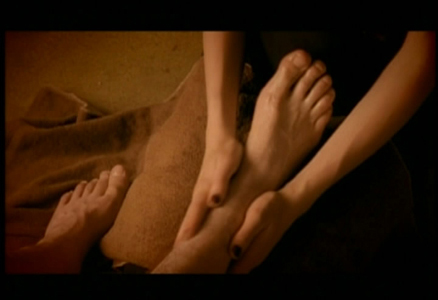
Do you understand?  Do you see what has happened here?  Jesus has taken the social/cultural world order and he has pulled it inside out.  The ones on the margin are now in the center.  The woman with a shoe in her face is now standing erect and dignified.  A race enslaved first by chains and then by laws and then by attitudes and economic policies is now standing erect and dignified.  The children slaving over our sneakers are now standing erect and dignified.  The man stooping to clean the toilets is now standing erect and dignified.  The undocumented immigrant bending over to pick our strawberries, fearing to be found out, is now standing erect and dignified.
 
We are all standing erect and dignified.  Because now we’re all at the master’s feet.  And we’re all being put into our proper place.  You know where that place is?  Prepare yourself.  Because you’re about to see something else dripping on those beautiful feet.  You’re about to see blood.  Because we’re coming to our proper place this coming week, my sisters and brothers.  We’re coming to the foot of the cross.  You’re coming to the feet of the cross, the feet with nails in them.  Keep your eye on those feet.  Keep your eye on those feet.  Keep your eye on those feet.

Thursday, March 7, 2013

Psalm 137 - The Beautifully Dangerous Psalm


Sermon  - The Rev. Leah D. Schade
United in Christ Lutheran Church, West Milton, PA

Listen to this song, “On the Willows.”  http://www.youtube.com/watch?v=RcgRQT8L7Zw


I remember the first time I heard this music from Godspell.  What a beautiful, mournful song, I thought to myself.  And I know I’ve heard those words before . . . “On the willows there we hung up our lyres”.  Such beautifully haunting words.  Where have I heard them before?  And then it hit me - Psalm 137.  But I noticed that the song’s lyrics stopped short of the last verses of the Psalm:  “Happy will be the one who does to you what you did to us, O Babylon.  Blessed will be the one who dashes your little ones, your babies against the rock.”

What an awful image!  It’s hard to believe a Psalm like this is in the Bible.  It is so violent - killing babies, of all things.  This is a far cry from Jesus’ words of forgiving your enemies and those who persecute you.  This is raw, uncensored hatred and desire for revenge.  Most people don’t even realize this Psalm is in the bible.  It is a dangerous psalm - a beautifully dangerous psalm.  So why is it in here?  What are we to do with a Psalm like this?

The presence of this kind of violent and vengeful language is off-putting to many people.  Some may even claim that this kind of wording authorizes revenge and retaliation.  So we have to handle this psalm with care.  Used in the wrong way, it could serve as an excuse to continue the cycle of violence and result in further bloodshed.  But we must be careful in our reading here.  The psalmist is not saying to go out and kill children and seek revenge.  Yes, it is expressing those thoughts and those wishes.  But it’s done as a prayer to God.  And that’s a very different thing than acting on those feelings and carrying them out.  

Let’s be honest - “desire for retribution and violence are in fact part of the human condition.”  (Murphy, 43).  Think back to the vitriolic language that erupted after the attacks on our country on Sept. 11, over a decade ago.  I heard more than one person say, “We should just bomb the whole Middle East.  I don’t care if we kill their children - might as well get them before they grow up to be terrorists and attack us.  Let’s just bomb them back to the stone age!”  And, we have.  We may not be personally bashing babies heads in . . . but our bombs and our guns have taken the lives of countless innocent children - collateral damage.  And, in what would be an ironic turn, it is quite possible that a person living in Palestine today may well be able to identify with these Jewish words desiring pay back and retribution.

But what about us?  For most Christians living in North America, a psalm like this is embarrassing, even offensive.  Why? Because most of us have never “lost that much, been abused that much, or hoped that much,” (Brueggemann, p. 75).  It is so difficult for us to pray this psalm because we simply cannot identify with it.  So what are we to do with it?  Is there another approach to this beautifully dangerous psalm?

Yes!  Here’s what we must do:  We must listen to it.  We must “hear the agony and even the sinful violence of human beings - in the context of prayer.  These expressions of rage exemplify the demonic in every human heart.  These feelings of revenge are not rare or unknown; everyone has experienced them.  When they are heard in prayer, they serve to illuminate our own feelings and even to accuse us of our own acts of vengeance.”  (Murphy, 46).  We live in a world marked by violence and revenge - wouldn’t it be prudent to put it into a prayerful context?  Wouldn’t it be wise to invite God into these feelings? 

That’s just what the psalmist does here.  You see, we have to understand the specific historical event that this psalm makes reference to.  This psalm reveals the sufferings and sentiments of people who experienced first-hand the terrible days of the conquest and destruction of Jerusalem in 587 B.C. This was their 9-11.  Their temple was destroyed - the very center of their faith.  And they were forced into the Babylonian captivity, when all the Jews were taken far from Jerusalem and lived as slaves of the Babylonians.  Even worse, they watched the enemy kill their children.  “You see, adults might be spared to serve various purposes for the conquerors, but the infants were killed to end the community’s future.” (Eaton, 455).

Once in Babylon, they experience profound homesickness, grief, depression, and despondency.  This scene from the psalm describes the Hebrew musicians sitting by one of the rivers in this hated land.  Their captors come along, taunting them, ordering them to sing happy songs about Zion.  What an ignorant, arrogant insult.  Of course they cannot sing happy songs about Zion in this foreign land.  They hang up their instruments in protest.  The holy songs cannot be sung on ground not dedicated to the Lord. To do so would be sacrilegious and bitterly ironic.  This kind of thing actually happened in the Nazi death camps, where Jews were forced to sing and dance their music and songs while the soldiers mocked them and laughed at them.  “It was a part of the humiliation intending to rob Jews of their identity, their dignity, and their hope.” (Brueggemann, p. 75).

The psalmist then makes a personal vow not to forget Jerusalem.  Not to forget the Temple that has been leveled, the city that has been burned, the king and leaders and musicians and teachers who have been led away to captivity in Babylon.  And then with a fury that nearly explodes from the page, he wishes for someone to exact revenge on the Edomites who plundered their city after the Israelites were gone, and upon the Babylonians who so mercilessly killed their children. 

We can only look upon these feelings with detached numbness.  We have never experienced this kind of suffering.  We build walls between us and the refugees in Sudan and Darfur, between us and the Afghans and Iraqis, between us and the woman who has been brutally raped.  We cannot bear such suffering, so we express outrage that such intensity of pain and desire for revenge is even voiced, much less in the Bible. 

The Old Testament historian Walter Brueggemann suggests that it is absolutely necessary to include a Psalm like this one in the canon.  Because it speaks with unfailing honesty about the abuse that was done, and is still done to individuals and to whole groups of people.  And it is necessary for us to hear how it feels to have this kind of violence and humiliation done to a person.  We want to move so quickly from this Psalm to Jesus’ Beatitudes.    But, as Brueggemann asks, “Could it be that genuine forgiveness is possible only when there has been a genuine articulation of hatred?” (Brueggemann, p. 77).

We need to recognize that healing is not just something we long for in our own bodies and in our personal relationships. Healing is something that is needed by our brothers and sisters around the world who have experienced the most humiliating kind of brutality.  By listening to their words, hearing their stories, and holding those powerful, violent emotions as best we can, we are at least acknowledging that, yes, that this has happened, and it is worthy of healing. 

Psalm 137 gives permission, actually authorizes the powerless who have been brutalized to vent their indignation and turn to God for justice.  “It is an act of profound faith to entrust one’s most precious hatreds to God, knowing they will be taken seriously.” (Brueggemann, p. 77).  And that is, finally, where we must direct our prayers. 

I invite you to come forward to this table of candles.  Maybe you’ll light a candle as a symbol for your own need for healing.  Or maybe you will see the candles and remember that someone is burning with pain and rage which needs to be seen and heard. . . and healed.  Hold that flame for a moment before you light your candle, and remember.  Listen to the anguished voices cry.  As hard as it is, hold that suffering for just a moment as a sign of your faith in the God who heals all.


Sources:
* Brueggemann, Walter, The Message of the Psalms:  A Theological Commentary, Augsburg Publishing House, 1984.
* Eaton, John, The Psalms:  A Historical and Spiritual Commentary withe and Introduction and New Translation, Continuum, New York, 2005.
* Murphy, Roland E., The Psalms, Job, from Proclamation Commentaries, Foster McCurley, Editor; Fortress Press, Philadelphia,1977. 


Sunday, March 3, 2013

Hope for the Fruitless Tree


Sermon, The Rev. Leah D. Schade                          Lent 3; Luke 13:1-9

I stand looking at that tree, shaking my head.  How could this have happened?  A perfectly good tree gone bad.  No fruit.  A complete waste of soil and space.  A hopeless case. 
19cuaresmaC3.jpg


What does that tree represent?  Most biblical commentators will say that the tree represents us, and that this parable warns us that you had better bear fruit, or God will cut you down like a fruitless tree.

It’s a plausible explanation.  Consider the previous verses.   Some people come to question Jesus.  What do you have to say about those Galileans killed by Pilate?  About those people killed by the Tower of Siloam? 
I stand with those people and I ask similar questions.  What do you have to say, Jesus, about those millions of people killed and left homeless by those earthquakes in Haiti and Chile? 

Now the ones questioning Jesus have a slightly different motive.  They don’t question why this terrible thing happened.  They want to know what these people did to deserve it.  They worked under the assumption that bad things happened because you did something to deserve it.  Their question to Jesus is laced with a poisonous self-righteousness.  

That assumption still exists today, even among some famous Christians, such as Pat Robertson whose analysis of the Haiti earthquake has led him to pronounce that it was a result of their forefathers supposedly making a pact with Satan centuries ago.  In other words, they brought this on themselves.  And aren’t we blessed that God hasn’t punished us with his wrathful vengeance?

And what is Jesus’ response?  Jesus will have none of that.  You think those people got what they deserved?  And that you’re somehow better than those people?  They were no better or worse than you.  You deserve to die just as much as they do because of your holier-than-thou attitude.  Unless you repent, you too shall perish.

And then this parable about the vineyard owner and the fig tree.  Like Jesus’ parables, this is a cryptic little story that leaves us hanging in the end.  “A man had a fig tree, planted in his vineyard, and he went to look for fruit on it, but found none.  So he said to the gardener, Cut it down!  Why should it use up the soil?
Wait, says the gardener.  Leave it alone for one more year, and I’ll dig around it and fertilize it.  If it bears fruit next year, fine!  If not, then cut it down.”

And that’s the end of the parable.  That’s it?  It leaves you wondering, doesn’t it?  What happens in the end?  Does the tree come back to life?  Is there fruit next year?  Or will the axe cut it down?

If the commentators are right, and we are the fig tree, we are left in a very precarious place, aren’t we?  It makes you wonder . . . Jesus is talking about repentance here.  Can a tree really repent?  Can a tree make a decision like that?  Is it the tree that really needs to repent?

What does it mean to repent?  The Greek word is metanoia.  It means to change one’s mind.  Jesus says to those questioners, You will perish if you do not change your mind.  If you do not change the way are thinking about this.  You need to change the way you are thinking about sin, about God’s wrath and judgment.  You need to change how you are seeing things.

I wonder if we need to change how we are seeing things in this parable?  Jesus’ parables are cryptic for a reason.  He says more than once that he tells parables in order to hide his meaning on purpose.  These parables are rarely as straightforward as they might seem at first.  Jesus tells parables to create a crack in the worldview of his listeners, a crack through which can be seen a glimpse of the Kingdom of God.  And once having this glimpse, your vision is changed, things shift, reality is altered just slightly enough to change your mind.

And whose mind needs to be changed in this parable?  Who is the one looking at the tree and seeing nothing but a fruitless, waste of space?  Who is the one ready to pronounce judgment on the tree, chop it down, see it as deserving nothing but death.  It’s not the tree that needs to change.  It’s the owner of the fig tree whose mind the gardener is trying to change. 

Those questioners are not the tree – they are the owner of the tree!  They are the ones looking at people affected by tragedy and making a judgment on them, ready to chop them down, seeing them as deserving nothing but death because of their fruitlessness, their sinfulness, their stupidity, their skin color, their economic level, their immigration status, their sexuality, their mistakes.

Don’t you see?  The owner of the tree is not God.  The owner is us.  We are the ones whose minds need to be changed.  We are the ones ready to chop down that tree without a second thought.  We are the ones impatiently making demands, ready to destroy the tree because it is not meeting our standards.

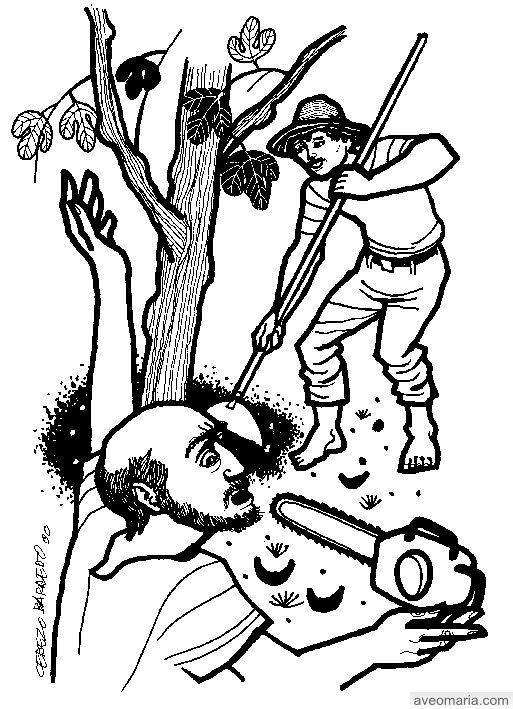
I have to admit, I am that fig tree owner with an axe in my hand, ready to start chopping.  I see nothing good coming from this tree.  I’m angry and I’m sad, and I’m ready to start making wood chips fly.
My questions are coming hard and fast.  Why did you let this happen God?  Don’t you love us?  Do you not care?  Do you even exist? 

Or rather - What did I do to cause this to happen?  What could I have done differently?  How could I have missed the signs?  Why did you let this happen, God?  Why did I let this happen?  What did I do to deserve this?  How did we end up with such a barren, wasted tree?  Hand me the axe, I’m ready to chop it down, I’m ready to give up hope, because I when I look at that tree I see nothing but emptiness.

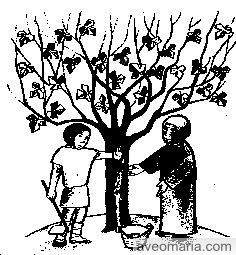
And then I look at that gardener.  What does the gardener do?  Does he sit around fretting about why God is allowing the tree to be cut down?  Is the gardener questioning the justice of the universe, falling into deep existential angst about the fate of the tree?  No!  He springs to action!  He does everything within his power to prevent the owner from giving up on the tree.  He pleads for the life of the tree, enthusiastically hauls out the shovel and wheelbarrow; lays out his plan for replenishing the soil with nutrients from the fertilizer; makes his case for giving the tree just one more year to bear fruit.  It may be a lost cause, but he’s not ready to give up yet.  When that gardener looks at that tree he sees life, he sees hope, and does everything he can to preserve whatever potential may be left in that tree.  The gardener sees that tree with the eyes of faith, despite all evidence to the contrary. 
The gardener does not get distracted wondering about why things are the way they are or what the tree might have done to deserve this.  The gardener does not write off the tree as a lost cause.  He gets in there, down in the muck and gets his hands dirty.  He grabs a shovel and starts digging.  He rolls up his sleeves, grabs a handful of that smelly fertilizer, and starts filling it in around the base of the tree. 
  
Because the gardener knows, if you throw in the towel every time something bad happens; if you write off a person, or a race, or a culture, or a prisoner, or a refugee, or a gay or lesbian, or an entire country because you think they deserve what they got; if you’re ready to chop down the tree every time it fails to bear the fruit you think it should, pretty soon you’ll find yourself surrounded by nothing but a bunch of dead stumps.

I know that it is a normal part of the process when tragedy strikes to wonder, why?  Why did God allow this to happen?  What did they do, what did we do to deserve this?  But don’t linger too long on those questions, because that is where the devil lurks to pull you into the quicksand of despondency or the fire of despotism , and you will be like those questioners who came to Jesus.  You will perish if you allow yourself to be dragged down by those questions.  

Listen to the gardener trying to change your mind, showing you a new perspective, trying to get you to see this tragic situation through the eyes of faith.  It matters not how or why we are in the mess.  What matters now is what we’re going to do about it.  The gardener says, Trust in God, even in the face of fruitless branches.  Don’t try to formulate a theory of illness, get in there and minister to the sick.  Don’t attempt to explain why the demons made the stones fall.  Get in there and cast out the demons as you’re hauling away the rubble.  Don’t try to develop a hypothesis for how prayer works.  Just get in there and pray.  This is a very practical, down-to-earth faith we’re talking about here.  We’re not interested in trying to explain evil, we’re here to overcome it. 

The gardener says, don’t despair when bad things happen to you.  And don’t get self-righteous when bad things happen to others.  Don’t get on your high horse and gloat that you think you’re better than others.  And don’t cower behind closed doors waiting fearfully for the onslaught.  Wake up each morning and say Okay, world, whatever you have in store for me today, bring it.  My joy will be magnified because I stand in the light of Christ.  My sorrow will be transformed because I stand in the light of Christ. 

I fear no evil, for thy rod and thy staff they comfort me.  I fear no evil because I look forward to seeing what God is going to do about it, how God is going to take a dead tree and throw manure around it and bring it back to life.  How God is going to take a crucified Jesus, hanging on that dead tree, and effect a miracle of transformation the likes of which the world has never seen. 

And so I stand here looking at that dead tree.  I stand here shaking my head.  And I watch that gardener fervently, foolishly digging, digging, digging around that tree.  And then the gardener beckons to me, and hands me a shovel.

Friday, March 1, 2013

Book Review: Fracking Pennsylvania by Walter Brasch


Reviewed by: The Rev. Leah Schade

As an anti-fracking activist, one of the most important things I've learned in this work is how necessary it is for us to be connected and know about each other's work, experiences, and information.  Walter Brasch has made a valuable contribution to that effort.  If I were teaching a course on environmental ethics, Brasch’s books would be on the reading list.  
Industry supporters who are derisive toward those of us who raise concerns about the safety of fracking will often repeat lines such as, "Bring your facts to the table.  Stop fear-mongering.  Base your arguments on scientific facts."  Thanks to Brasch, we can do just that.  His book is replete with facts, figures, dates, and exact quotes (all meticulously footnoted) from industry and government officials on fracking.  It is all woven together in a cohesive way that takes the reader through the complexities of issues surrounding shale gas drilling. If you are not alarmed and fearful while reading Brasch's book, you are not sufficiently engaging its content.